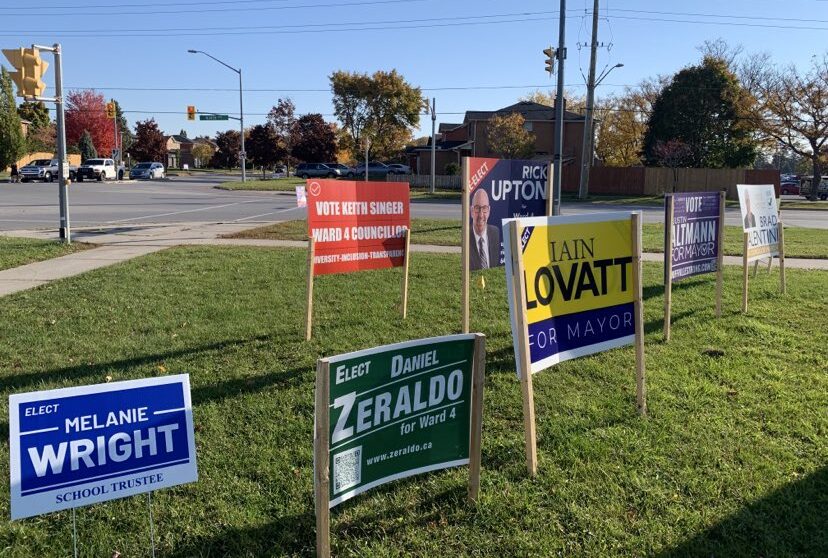
- Council approved amendments tightening rules for election signage on Stouffville’s public lands.
- Candidates are now limited to three designated public intersections per ward, with one sign allowed per intersection.
- Signage on private property remains unrestricted with owner or occupant permission.
- The by-law aligns closely with York Region’s updated rules for Regional roads and intersections.
- In a tie vote, Council rejected a proposal to ban all campaign signage from public property.
- New rules also clarify signage permissions for campaign offices and reinforce restrictions near polling stations.
Campaigns running in Whitchurch-Stouffville will face tighter rules around election signage beginning this year, following Council’s approval of amendments to the Town’s Election Signs By-Law on Jan. 21.
The changes significantly restrict the use of public lands for campaign signs, limiting each candidate to just three designated public intersections per ward, with only one sign permitted per intersection. The placement of election signs on private property remains unrestricted, provided the appropriate owner or occupant has granted permission.
The amendments bring Stouffville’s by-law largely in line with York Region’s updated election signage rules for Regional roads, which were approved in December. Most major intersections involving at least one Regional road will continue to permit a single sign per candidate; however, signage has been prohibited at three intersections along Ninth Line, as well as at intersections involving Highway 48 and Highway 404.
While previous by-laws allowed election signs on public lands along any roadway, the updated rules now confine signage strictly to the preapproved intersections. A full list of eligible Stouffville intersections is included in the Staff report accompanying the by-law update, and the Town has published an online map identifying the 18 intersections.
The alignment will “[ensure] consistency for sign placement, size, and safety on both Municipal and Regional roads,” Staff wrote in the report. They also noted difficulties narrowing down the best three intersections for each ward, saying they worked to identify appropriate locations that offered maximum exposure.
The by-law includes standardized size limits, with campaign signs restricted to a maximum height and width of four feet, for a total allowable area of 16 square feet. Staff further clarified that height measurements will now include the full distance from ground level to the top of the sign, noting the change is intended “to ensure consistency with York Region and ensure signs don’t block sight lines.”
Signs placed within municipal intersections must also be supported by wood stakes or posts. Staff said the requirement improves stability and addresses environmental and safety concerns raised by York Region, including issues with wire frames “interfering with grass cutting and creating hazards when left behind.”
Council considered further restrictions during its deliberations. Councillor Rick Upton introduced a motion that would have eliminated roadside campaign signage from public property altogether, leaving private lands as the only permitted option. Citing population and geographic differences between wards, Upton argued a full prohibition would be simpler and more equitable.
“Campaigning is not how many election signs you can slap everywhere, campaigning is about advising people of the community about what you’re going to do or not do to make their lives better,” Councillor Keith Acton said after seconding the motion. “I think our community has been saturated with signs in previous elections, and it adds up to sign pollution.”
The motion failed on a tie vote, with Upton, Acton, and Councillor Sue Sherban in support, and Councillors Hugo Kroon and Maurice Smith, along with Mayor Iain Lovatt, opposed. Later in the discussion, Kroon cautioned that overly restrictive signage rules could disadvantage first-time candidates, who may feel a need to rely more heavily on physical signage to build name recognition within their wards.
Council also addressed campaign offices, which had not previously been covered by the Town’s election signage rules. Under the updated by-law, campaign offices will be permitted to display only one election sign during an election period.
The by-law defines an election sign as one containing “words or symbols such as elect, vote, re-elect, support, campaign for, or any similar wording that promotes voting for or against a candidate.” Election signs, including roadside campaign signs, are only permitted once the writ has dropped for a provincial or federal election, or 28 days before a municipal election.
Other election-related visuals, including a candidate’s name, photograph, campaign colours, and supportive messaging, are not subject to election sign restrictions, provided they comply with the Town’s general signage and advertising by-laws.
“You could go open an office right now, in your ward, and use it as a constituency office. It could have your name and your photo, or whatever else you want to put in the window,” Lovatt said, further highlighting permissions already in place.
Additional restrictions were codified around polling locations, with campaign signage prohibited on any vehicles “parked at or adjacent to voting places, and at any Town-owned facility.” Staff said the change is intended to “keep public spaces neutral and accessible during elections.”
While Staff recommended moving Election Sign By-Law penalties under the Administrative Monetary Penalty System, Council amended the item to maintain current enforcement protocols.
Campaigns will continue to pay a signage deposit, and $10 will be deducted for each illegally placed sign recovered by the Town throughout the election cycle. The deposit is used to offset municipal costs associated with sign removal and disposal.
Cover image taken by Arnold Neufeldt-Fast