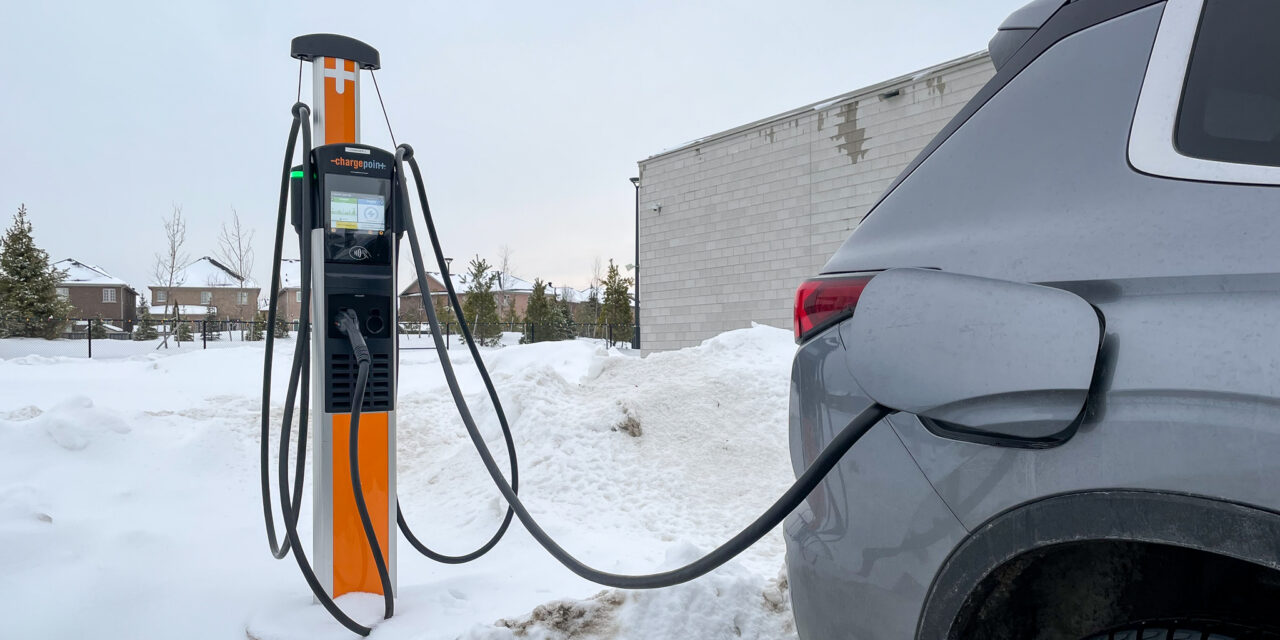
- Four Level 2 EV charging ports are now operating at the Stouffville Leisure Centre.
- Total project costs were approximately $65,000, supported by $30,000 in Provincial funding.
- Ontario’s ChargeON grant program is intended to expand public charging networks and access while encouraging EV adoption.
- The charging stations are located in the south Leisure Centre parking lot and cost $2 per hour to use.
- Mayor Iain Lovatt described the installation as the first step in a broader push for more local EV charging stations.
The Town of Whitchurch-Stouffville has added four Level 2 electric vehicle charging ports at the Stouffville Leisure Centre. The new EV station expands local access to public charging and supports broader climate and transportation goals, the Town says.
The chargers are operating in the south parking lot near the Memorial Park Skating Trail, offering residents a convenient place to plug in while using nearby public facilities. Charging is set at $2 per hour, a rate comparable to Level 2 charging in Toronto Green P lots and lower than the $2.70 municipal rate in neighbouring Aurora.
Total installation costs were estimated at $65,000, with $30,000 provided through Ontario’s ChargeON Electric Vehicle Charging Infrastructure program. The initiative is designed to expand the province’s public charging network, improve affordability and access, and encourage more drivers to transition to electric vehicles.
Eligible projects must introduce new public charging locations rather than expand existing sites, helping extend coverage into more communities and address service gaps.
“The installation of what I hope will be the first of many EV charging stations across our community marks an important step for Stouffville,” Mayor Iain Lovatt said in comments to Bullet Point News. “By supporting residents who are making the switch to electric vehicles, we are reducing range anxiety and making it easier for local families and visitors.”
Municipal officials say the project aligns with the Town’s broader environmental priorities, including cutting greenhouse gas emissions, supporting alternative transportation options, and embedding sustainability into public facilities and infrastructure.
“Expanding this infrastructure will help future-proof our town, support responsible growth, and advance our local and regional sustainability goals,” Lovatt added.
Electric vehicle chargers are generally categorized into three levels based on power and charging speed. Level 2 units, like those installed at the Leisure Centre, are commonly used in homes, workplaces, and public parking areas, operating on 240-volt power to provide a steady charge that can add roughly 15 to 50 kilometres of range per hour.
Level 1 chargers plug into a standard household outlet and are best suited to slower, overnight charging at home. Level 3 stations use high-voltage direct current to recharge vehicles much more quickly, typically along highways and at major commercial sites.