- Stouffville may consider a temporary waiver of development charges for large new industrial, commercial, and institutional projects as a potential economic incentive.
- The proposal is intended to help diversify the Town’s tax base and reduce long-term reliance on residential taxpayers.
- Forgoing DCs would mean losing hundreds of thousands to millions in upfront capital revenue per qualifying project.
- Additional ICI property taxes could offset those losses over time, but returns would accumulate gradually rather than immediately.
- A motion from Mayor Lovatt is seeking a Staff report to model risks, impacts, and potential economic benefits before making a final decision.
- The discussion reflects broader municipal concerns about capital funding pressures and provincial policy changes affecting DC revenues.
As the sector struggles, municipalities across Ontario are weighing development charge (DC) reductions and deferrals to stimulate new residential construction. However, difficult questions are emerging about communities’ ability to continue funding long-term capital needs and growth-related infrastructure.
While they vary by municipality, DCs can add tens of thousands or even millions to the costs of a new project. Those revenues, however, are a primary tool for financing roads, pipes, and other infrastructure required to support growth. When DCs are reduced or removed, municipalities must make up the difference through higher property taxes, additional debt, outside funding, or the deferral and cancellation of capital projects.
In Whitchurch-Stouffville, that balancing act is further complicated by an imbalanced tax base. Despite gradual improvement in recent years, roughly 90 percent of the Town’s annual tax revenue is still generated by residential properties, with industrial, commercial, and institutional (ICI) taxpayers contributing the remaining share. Expanding the non-residential assessment base has been a stated priority of Mayor Iain Lovatt and Council as a means of easing long-term pressure on local homeowners.
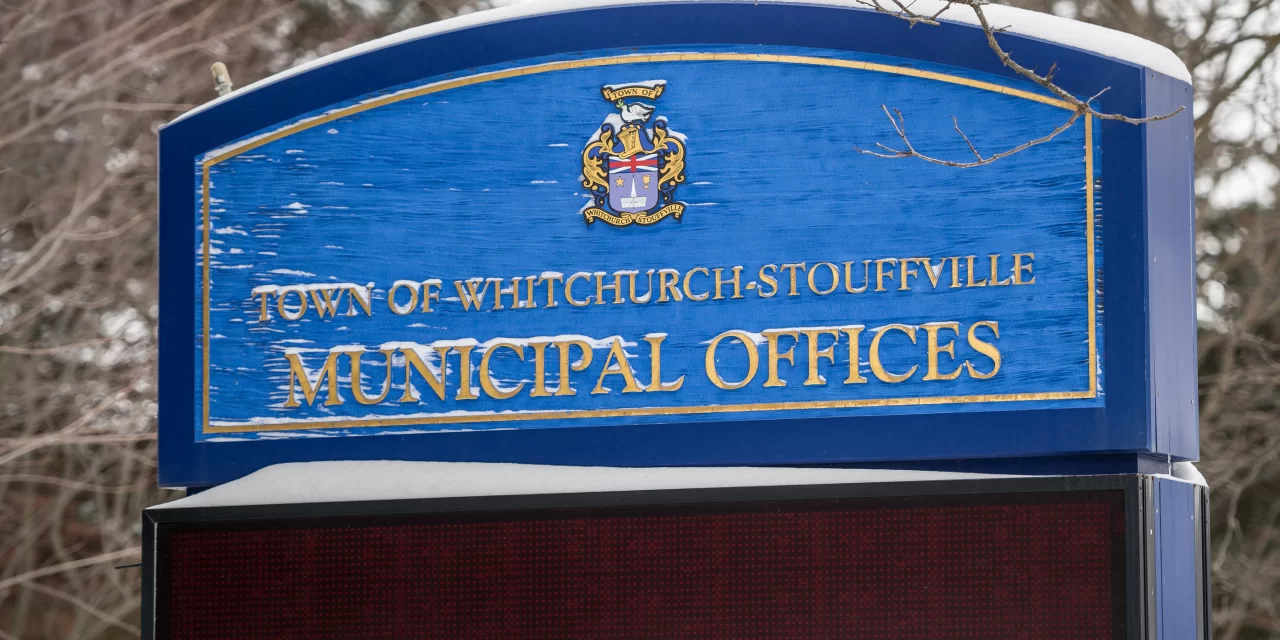
On Feb. 4, Lovatt will bring forward a motion asking Staff to explore temporarily waiving the Town’s development charges for new ICI projects larger than 100,000 square feet. While the policy would result in a loss of upfront capital revenue, it could also generate new ongoing property tax revenue the Town might not otherwise realize.
The motion proposes a two-year incentive window, arguing that “expansion of the Town’s ICI assessment base is essential to improve long-term financial sustainability, reduce reliance on residential taxpayers, and support a more diversified municipal revenue structure.”
The proposal also acknowledges the financial risk inherent in foregoing DC revenue. The motion calls for a report examining the feasibility, fiscal implications, and potential economic benefits of such a program, including modelling the value of lost DCs against the long-term property tax revenue a large non-residential development could generate.
According to Stouffville’s most recent Development Charges Guide, the Town’s share of DCs for new non-residential gross floor area ranges from $7.23 to $11.90 per square foot. For a 100,000-square-foot ICI development, that translates to a one-time revenue loss of approximately $723,000 to $1.19 million, depending on existing water and wastewater servicing.
Another example, White Owl Properties’ nearly 700,000 square foot ICI development proposal on Woodbine Ave., would be relieved of approximately $5 million in owed development charges based on current rates.
In comments to Bullet Point News, Lovatt said the Town has made “some great progress” in attracting new employers to Stouffville in recent years. He noted that most of that growth has occurred in the Town’s western settlement areas, including the hamlets of Gormley and Vandorf, while again highlighting the inability to expand such development onto protected Greenbelt and Oak Ridges Moraine lands along the Highway 404 corridor.
“Given the Town’s industrial and commercial tax deficiency, and with no expansion currently available along the 404, we need to explore every tool in the toolbox to incentivize and attract new industrial and commercial development for the lifetime value of future taxes” Lovatt said.
Estimating the offsetting tax benefit is less straightforward. Property value and classification influence the outcome, with the Town’s current annual ICI tax rates ranging from approximately four to five percent of the assessed value. In practical terms, non-residential properties are taxed at rates roughly one-third to nearly two-thirds higher than homes, underscoring why Stouffville is pursuing employment-focused growth.
In a statement provided to Bullet Point News, Town spokesperson Glenn Jackson said a 100,000-square-foot industrial facility in Stouffville could pay approximately $255,000 in total annual property taxes. With the Town’s share representing about 34 percent of that amount, municipal revenues would total just over $85,000 per year.
“This tax amount is based on the assessed value of the property, so that amount will vary depending on the application and site,” Jackson reminded.
The broader concern inherent in Lovatt’s concept is timing. Development charges provide immediate capital funding, while equivalent property tax revenue would accumulate gradually over many years. Under Jackson’s scenario, it would take more than eight years of municipal taxation to offset even the lowest estimated DC loss should a waiver be granted.
Potential impacts on the Town’s capital planning and the likelihood of increased borrowing would require careful analysis, as servicing costs could be shifted onto existing taxpayers if capital projects proceed without adequate upfront funding. Any resulting delays to growth-supportive infrastructure, in turn, can prove counterproductive by slowing both housing delivery and broader economic expansion.
Those pressures are not unique to Stouffville. Speaking at York Regional Council on Jan. 29, Newmarket Mayor John Taylor warned of the longer-term fiscal fragility facing municipalities as both local and provincial decisions continue to affect development-related revenue streams.
“I don’t think the public understands how tenuous this is, around whether we can keep building infrastructure, [great communities, and amazing spaces,] and whether we’ll even have a financial balance sheet in 20-25 years that doesn’t start to look more like some American cities,” Taylor said.
Similar concerns were raised by Mayor Lovatt in a budget deputation to the Province on Tuesday, pointing to growing budget pressures and the limits of relying predominantly on residential property taxation to fund expanding communities.
Lovatt’s proposed study, if approved by Council next week, would task Town Staff with testing whether short-term forgone revenue could realistically be outweighed by long-term assessment growth. The question is not simply whether development charges can be reduced, but whether the economic activity and future tax contributions generated in their absence would be enough to justify the immediate fiscal trade-off.