- Mayor Iain Lovatt introduced a Regional Council motion directing Staff to review last-mile and on-demand transit models for municipalities like Stouffville.
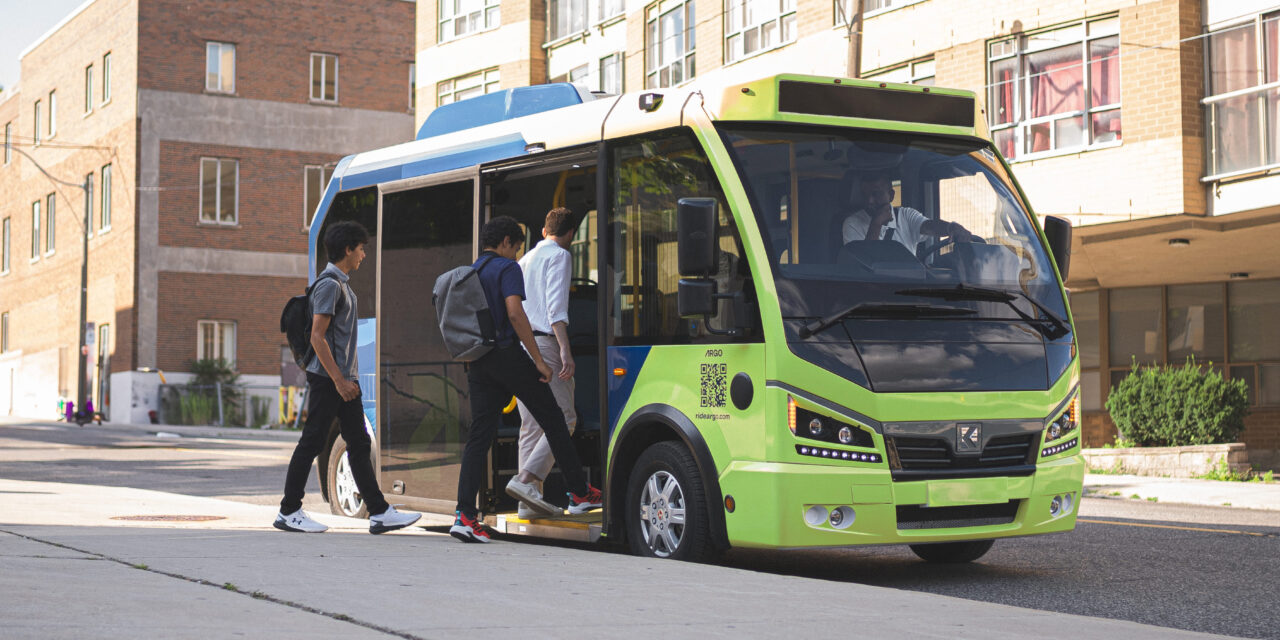
- The motion asks Staff to evaluate Mobility On-Request, assess technologies such as Argo’s bus system, and propose improvements.
- Lovatt said he envisions Argo-style buses complementing, not replacing, YRT’s existing on-demand service.
- The Mayor emphasized the importance of visible, higher-capacity vehicles to encourage regular transit use.
- First- and last-mile connections, he says, are critical for connecting riders to higher-order transit and reducing car dependency.
- Lovatt said YRT could pursue a partnership with a private provider or implement an in-house model, depending on Staff findings.
York Region will take a closer look at emerging on-demand transit models, including services like Argo’s electric buses. The upcoming review follows a motion introduced by Stouffville Mayor Iain Lovatt at Regional Council’s Dec. 11 meeting.
The motion directs Regional Staff to assess the current state of York Region Transit’s (YRT) Mobility On-Request program, evaluate new service delivery models, and recommend steps to improve transit in underserved municipalities such as Stouffville.
The request also aligns with Metrolinx’s 2041 Regional Transportation Plan, which identifies first- and last-mile connections as essential to supporting future ridership. The first and last mile refer to the short but often inconvenient distance between a rider’s home and the nearest major transit route or station. When that gap is left underserved by transit, commuters are far more likely to default to driving.
There is also growing recognition of the significant costs and challenges associated with providing parking at transit stations as communities expand. “It is not sustainable to rely primarily on rapid transit users driving to stations and parking for free. New solutions are needed,” the Transportation Plan reads.
In pursuing those solutions, the Mayor said his intent is not to replace YRT’s existing On-Request program. Instead, he wants to build upon it. Lovatt sees space for a complementary service model, one that uses higher-capacity vehicles, to strengthen local transit and make it a more compelling alternative to personal vehicles.
“I don’t believe it’s a duplication of Mobility On-Request. And in the consumer’s mind, I think they look at On-Request as more of a ride sharing service than anything else,” he said in a conversation with Bullet Point News. “When you think transit, you think buses and trains. There seems to be a conceptual dissonance in people’s minds when it comes to comparing Mobility On-Request against traditional YRT services.”
The motion, in part, aims to begin a broader conversation about how the Region can adapt its on-demand system to serve as a true last-mile connector. Lovatt believes this is where an Argo-style model could be transformative, arguing that more visible buses operating frequently within neighbourhoods could both normalize and boost local transit use.
He added that while YRT’s incremental service expansions have produced measurable ridership gains in Stouffville, an on-demand bus system using shorter, high-frequency vehicles would drive even greater adoption. “People are using YRT in Stouffville, but it’s not to the same level as if there was a short bus rolling through town,” he said.
Lovatt pointed to Brampton as an example, where Mayor Patrick Brown worked to introduce Argo as a standalone on-demand option. Operating within a defined urban grid, he said the service has demonstrated strong efficiencies and increases in transit connections.
“When the report comes back following this motion, it will need to identify needs for first- and last-mile rides within underserved areas,” Lovatt explained. “It could look at the business model of Argo and say ‘yes, it makes sense for us to partner with them,’ or ‘no, we can do this on our own.’”
Any future partnership with York Region must comply with its procurement policies, and Regional Council is not able to direct Staff to enter YRT into an agreement with Argo. If the Region reached a point where it was interested in bringing on third party support, an open and transparent tender process would need to occur.
Lovatt said he would not be surprised if Staff recommends piloting an in-house version first. “They aren’t electric, but we could roll YRT’s standard short buses through Town and see what happens,” he said.
The Mayor also underscored that Argo is primarily a technology company, not a bus manufacturer. Its navigation software uses AI to assess trip requests and optimize routes in real time, and Lovatt said similar technology could support future On-Request upgrades.
“YRT is roughly in the middle of their software provider contract, which was engaged to develop their app,” he said. “When they go back out to tender to renew that service, I think looking seriously at what Argo has to offer is a no brainer, because it’s impressive tech.”
He also noted that Argo vehicles used in existing Ontario programs are manufactured outside Canada, a factor that YRT could address through its own procurement preferences.
“I haven’t seen numbers from Argo that show their value proposition is undeniable, but I think, through this process, we can get there,” Lovatt concluded. “At the end of the day, whether it’s YRT, Argo, or somebody else, I just want increased service in town.”
Cover image was provided by, and is property of, Argo