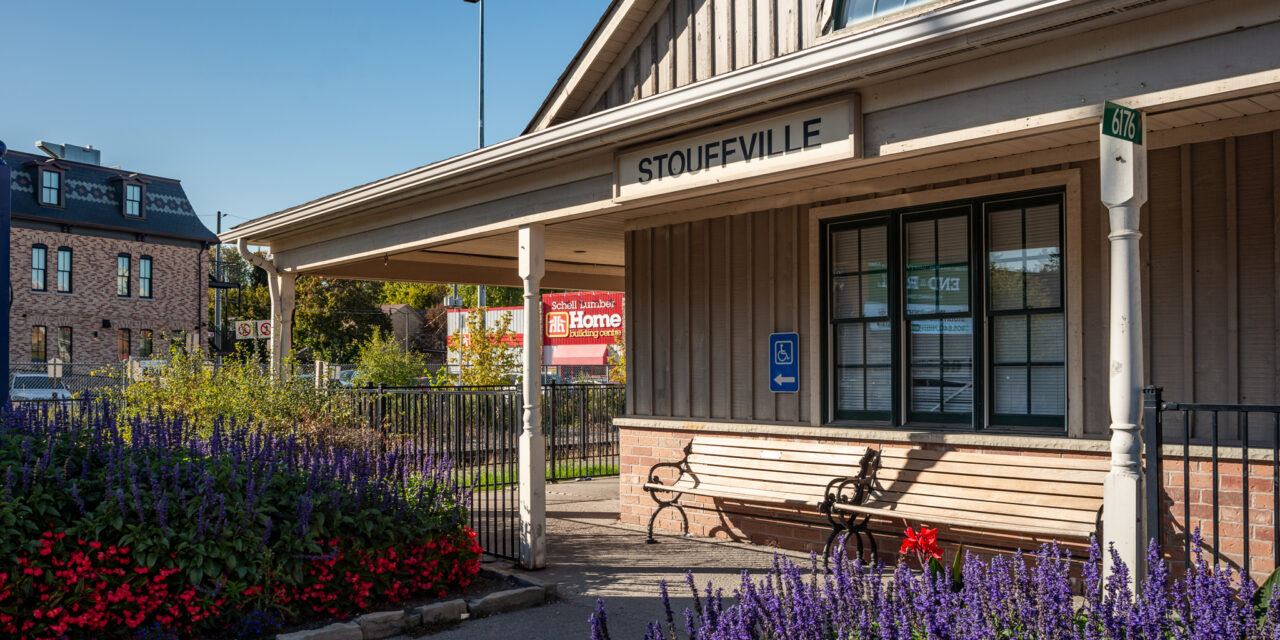
- Ontario approved Stouffville’s new Official Plan on Sept. 25, formally designating lands around the Stouffville GO station as a Major Transit Station Area (MTSA).
- Mayor Iain Lovatt pushed for a proactive approach, with Council directing Staff to create a detailed block plan to shape the MTSA before developers move in.
- The block plan will go beyond high-level land-use policies, setting out specific blocks for housing and employment, public spaces, infrastructure, and mobility.
- The MTSA is bounded by Edward Street and Main Street, with building heights capped at 10 storeys overall and six storeys along Main.
- While the Town believes it can meet those density targets, Lovatt warned the Province could allow “unlimited” building heights with no parking near GO stations.
- The future of the former Stouffville District Secondary School site remains uncertain, with the Town interested in acquisition but facing high potential costs.
- Lovatt stressed that without a block plan, the Province could dictate development outcomes, underscoring the need for local vision and control.
After a lengthy review process, Ontario’s Ministry of Municipal Affairs and Housing approved Stouffville’s new Official Plan on Sept. 25. The decision formally designates the lands surrounding the Stouffville GO station as a Major Transit Station Area (MTSA), raising the spectre of significant future intensification.
Under the Provincial Planning Statement, the Ontario government requires higher densities and mixed-use development within MTSAs. While the Town has already conducted a land-use study for the Old Elm MTSA, Mayor Iain Lovatt is urging a proactive approach for the Stouffville GO station lands.
“Because our Official Plan is now adopted, and the [Stouffville] and the Old Elm GO stations are now officially major transit station areas, [there is] a need for us to be proactive in creating a vision for this area…that has the community in mind,” Lovatt said during a Council meeting Wednesday. “Not one…where we sit back and we wait for parcels of land along Edward Street to be bought up by developers, and then they bring us what they think…we want.”
In approving a member motion from Lovatt during the meeting, Council directed Staff to prepare a comprehensive block plan for the Stouffville GO MTSA. Before any development applications are submitted, the plan will set out a framework for land use, building design, infrastructure, mobility, and phasing, guided by the principle that the area will be supported by multiple modes of transit.
It is designed to support the coming higher-density housing and increased employment opportunities, bringing together a mix of uses within a walkable community. In comments to Bullet Point News, Lovatt explained how the approach will differ from the land-use study completed for the Old Elm MTSA..
“A land-use study is very high-level. It sets policy around general land uses within a larger area,” he said. “A block plan is more granular. It identifies blocks within a specific area for different types of development. With our new Official Plan now in place, and its general policies outlining MTSAs, a block plan for the Stouffville GO station area is the prudent course of action.”
In other words, the block plan will translate those higher-level planning policies into a more precise, on-the-ground vision for how the community will take shape. Added context will also be given to future applicants by illustrating how proposed projects can align with both existing surroundings and future development, addressing aspects such as the form and placement of buildings, street networks, public spaces, and cycling and walking connections.
The Town describes the Stouffville GO MTSA as generally covering lands on the east side of Edward Street between Main and south of Millard, along with properties on either side of Main Street from Albert Street to west of Pine Street. A map of the area is included in Schedule D-1 of the new Official Plan.
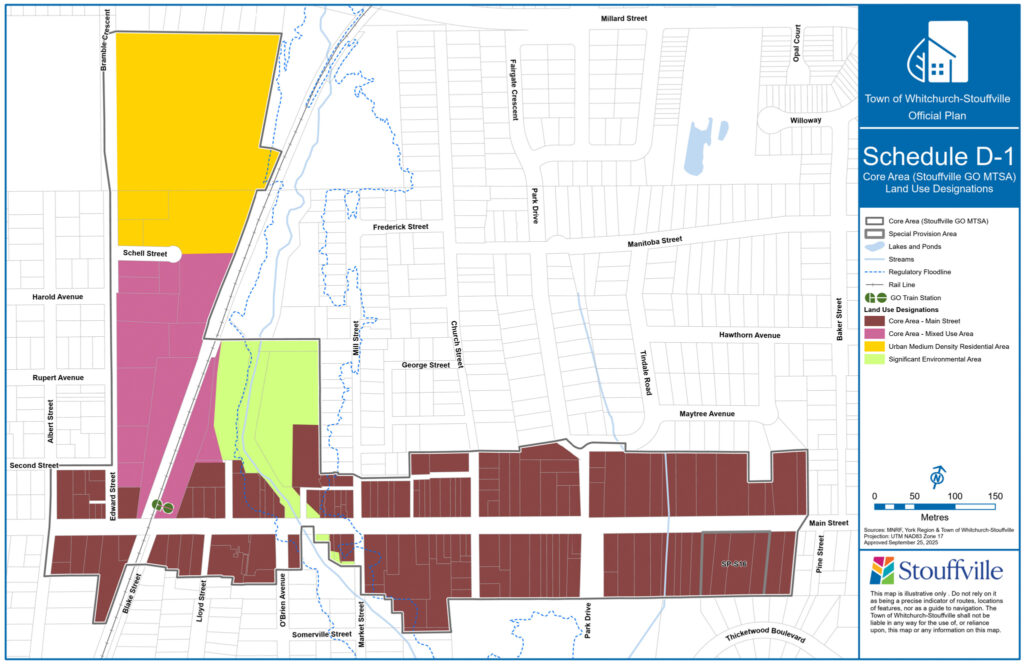
The Town has mapped the Stouffville GO MTSA in its recently adopted new Official Plan.
An MTSA carries a minimum density target of 150 people and jobs per hectare. According to the Official Plan, Stouffville can meet the target with heights capped at 10 storeys, while limiting development on Main Street to a maximum of six.
However, Lovatt cautioned that future Provincial directives could push for even greater intensification. “We have heard the Province tell us that, around GO stations, there could be an opportunity for condominiums [with] zero parking and unlimited heights. And unlimited means unlimited,” he said, underscoring the Town’s interest in trying to shape outcomes before they are imposed.
The motion also pointed to the development potential of key publicly owned lands within the MTSA, including Metrolinx-owned parcels and the former Stouffville District Secondary School site on Edward Street. These properties could act as catalysts through partnerships with other levels of government and agencies.
The future of the vacant York Region District School Board property remains unknown. While the Town has expressed interest in acquiring the former high school lands to gain greater control over their eventual use, the board has yet to determine whether it requires the site to meet long-term needs. If it were to sell, Stouffville would have the right of first refusal. However, as the property now falls within an MTSA, market rates could make the asking price prohibitively high.
Ward 1 Councillor Hugo Kroon said the site has sat in limbo for nearly 20 years, with little clarity from the Province or YRDSB. “It’s been a long-time concern with the former high school lands… We are having a hard time understanding exactly what the Province has planned,” he said.
While acknowledging the Ontario government’s expectation for intensification, Kroon stressed that the Edward Street lands are central to Stouffville’s goals. “Those high school lands have to come into our ownership, or into a development partner that’s going to work with us and share the same vision.”
Lovatt echoed that perspective, recalling a recent delegation with the Ministry of Education in Ottawa. Without a local planning framework in place, he warned, the Province could intervene and impose its own direction.
“It did come up that the Province could step in and actually dictate what happens on that property in the absence of a block plan like this,” he said. “We have very little ground to stand on because we don’t have a plan.”
With Council’s direction, Staff will engage the Ministry of Education, Metrolinx, community members, and other stakeholders to ensure the block plan reflects local priorities and public input. “ This is a great initiative, and one that [is] going be very important to how we watch our town grow,” Kroon said. “Growth, of course, is inevitable, but we have the opportunity to do it right.”