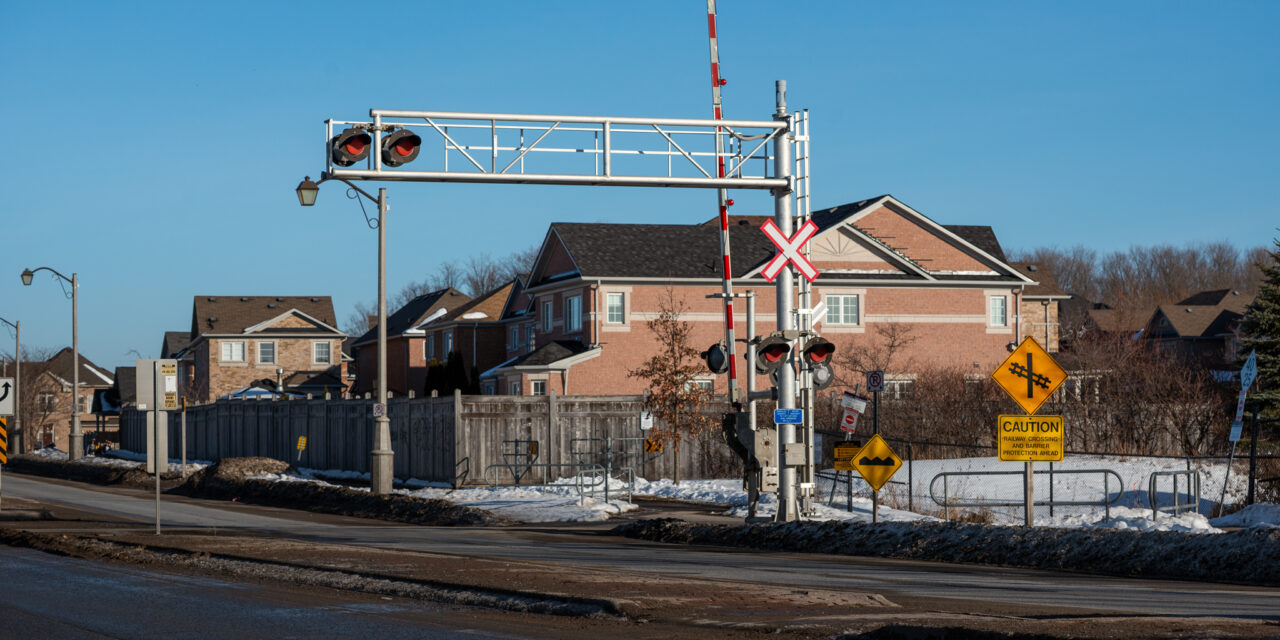
- Whistle cessation at the Hoover Park and Reeves Way rail crossings continues to face delays.
- Improvements and safety upgrades at the two crossings are required before whistle cessation can be implemented.
- A Metrolinx policy restricting work when GO corridors are active has limited construction windows and added complexity.
- Flagging requirements and expanded scope, including removal of the Hoover Park crossing hump, are increasing costs.
- Less than $59,000 remains in the project budget, meaning additional funding will likely be required.
- Weekend corridor closures in April and June could provide roughly 100 hours of consistent access for more efficient work.
- Completion of the two crossing projects is expected this year, Mayor Lovatt said.
For households bordering the Stouffville GO line, relief from train whistles has been a long time coming. As whistle cessation planning for the Hoover Park and Reeves Way crossings inches forward, new conditions from Metrolinx are reshaping timelines, expanding project scope, and increasing costs.
Initial capital funding for whistle cessation was approved in 2019, and the budget was updated in 2023 using high-level costing assumptions. Following an October 2024 decision meant to build momentum for the project, Staff proceeded with tendering necessary construction work before final design approvals were secured from Metrolinx.
The Town awarded a $221,000 contract for the crossing improvements to Lyncon Construction last April. A recent report touched on their early construction coordination meetings with the transit agency, saying it soon “became apparent that Metrolinx would require additional measures to be implemented in order to obtain approval.”
Speaking during Council’s Feb. 18 meeting, Commissioner of Engineering and Public Works Jack Graziosi said Metrolinx is restricting work to nighttime hours, calling it the “least disruptive time” for railway operations.
Metrolinx eliminated red-zone work along its rail corridors in September 2025. The practice involves construction while tracks remain active and carries heightened safety risks for crews. Exceptions are only permitted where green-zone work, which is conducted when trains are not using the corridor, is not feasible.
Red-zone restrictions present practical challenges along the Stouffville GO line, which typically operates from 5 a.m. to 1 a.m. The sole four-hour overnight work window would result in cost increases and extended timelines, and officials have pointed to planned weekend corridor closures in April and June as more efficient opportunities to complete much of the crossing work.
Mayor Iain Lovatt said the two closures could provide roughly 100 hours of consistent access to advance the upgrades, which must occur before whistle cessation can be implemented.
The report also notes the need for flagging operations, which involve trained personnel managing movements within the corridor to protect workers. Just under $59,000 remains from the project’s $378,392 budget, an amount Staff say is unlikely to cover the added expense.
Senior Town Staff have met with Metrolinx to explore ways to limit further spending. Beyond identifying the two weekend closure opportunities, Metrolinx committed to conducting “an extensive review with a goal of reducing some of the requirements associated with the works, which would reduce the costs to the Town.”
Bullet Point News reached out to Metrolinx for comment regarding the conditions affecting construction and their efforts to mitigate impacts through coordination with the Town.
“We are actively exploring ways to support the Town in completing the project safely and as quickly as possible,” a Metrolinx spokesperson said, highlighting that whistle cessation is a municipally led process. “We continue to meet with the Town on a bi-weekly basis and are working with them as they advance this important initiative.”
While Stouffville had hoped work would be done last summer, construction is now expected to start in the second quarter of this year. Completion is anticipated in the fall, and Ward 6 Councillor Sue Sherban said addressing financial uncertainty was the central concern before Council on Wednesday.
“This is really about the budget,” Sherban said in a conversation with Bullet Point News. “This report came forward so there will be no surprises in the spring, as there may be a need for a significant amount of money because Metrolinx won’t pay for the flagmen.”
Further complicating matters, Metrolinx also determined the large hump at the Hoover Park rail crossing must be removed. While likely to please area motorists, the condition expands the project’s scope beyond earlier assumptions.
Sherban said the drawn-out process reflects broader frustrations with Metrolinx. “That’s a massive requirement that was never there,” she continued, adding that ongoing discussions between the Town, Lyncon, and Metrolinx will help clarify final costs.
“It takes us six years to get approvals for two simple crossings, but they can approve engineering plans for the Indy track around Unionville GO within a year?” Sherban asked rhetorically. “There’s something really imbalanced in how they treat a community like Stouffville.”
Acknowledging the challenges during Council’s meeting, Lovatt emphasized that the project is moving in the right direction. “As complicated and as bureaucratic as Metrolinx is, we are making progress,” he said. “This work will be completed this year.”
The Mayor described a “revolving door” of staff on the file at the provincial agency, which has required repeated engagement. Recent interactions with new Metrolinx CEO Michael Lindsay have been more productive, he said.
Lovatt noted that whistle cessation is a Town-led initiative, and that Metrolinx is entitled to prioritize its own projects. Stouffville will also need to repeat the process for the Main Street crossing following reconstruction.
Graziosi said the first stage of securing flagging operations has been completed, and further updates from Metrolinx are expected in the coming weeks. Requests for additional funding beyond the approved budget will be brought forward in a future report for Council consideration.