- Stouffville is considering zoning changes that would allow for more dense housing types in existing serviced neighbourhoods.
- Duplexes, triplexes, and fourplexes, as well as townhouses and semi-detached units, could be permitted in all residential zones.
- Small apartment buildings up to four storeys could be allowed along parts of Main Street, Ninth Line, and Tenth Line.
- Most new housing forms would still follow similar height, lot coverage, and setback rules as detached homes.
- Parking requirements for apartments and stacked townhouses could be reduced to lower housing costs.
- Under new Provincial rules, parking minimums will no longer apply to new development near Stouffville’s two GO stations.
- Residents will be able to comment on the proposed changes during a public meeting on March 11.
Town Staff will present draft Official Plan and Zoning By-Law amendments next week aimed at expanding housing options and increasing density within fully serviced neighbourhoods.
The proposals stem from Stouffville’s 2024 Housing Action Plan, developed as part of the Town’s successful Housing Accelerator Fund (HAF) application. Among its commitments were studies examining how missing middle housing could be integrated into existing residential areas and whether parking requirements for larger developments could be reduced.
Completed through the Town’s ReZone + ReDesign project, the resulting amendments will be outlined during a statutory public meeting on March 11. The session begins at 7 p.m. in Council Chambers, where residents and Members of Council will have an opportunity to comment on the possible changes.
“We need to respond to today’s housing crisis while also thinking ahead. What do we want Stouffville to look like 20–30 years from now?” Staff wrote in a report attachment for Council. “Do we want to remain car-centric, or create flexible communities with enough density to support active and transit-oriented living?”
The Need for Missing Middle Housing
Population projections from York Region and the Town estimate Stouffville could grow to between 88,100 and 103,000 residents by 2051. Currently, roughly 75 percent of the community’s housing stock consists of single-detached homes.
While some currently unserviced lands are expected to be opened for development in the future, Staff have repeatedly pointed to environmental protections governing the Oak Ridges Moraine and Greenbelt as significant constraints on outward growth.
“The housing market is not addressing the Town’s needs,” Staff stated in a December 2025 presentation. They noted the need for homes suited to a wider range of residents, including seniors looking to downsize, moderate- and lower-income workers, and families unable to afford larger detached homes.
To help address gaps and catalyze gentle density, the Town explored “how different housing types, such as multiplexes and low-rise apartments, can be integrated into existing neighbourhoods.”
At a high level, the proposed amendments would expand permissions for housing forms such as duplexes, triplexes, and fourplexes, which typically contain stacked independent units in various configurations. Semi-detached homes and townhouses would also be permitted across all residential zones.
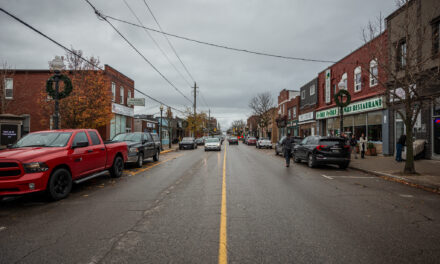
Smaller-scale apartment buildings, generally three to four storeys with five or more units, could also be permitted along portions of Main Street, Ninth Line, and Tenth Line, as well as limited adjacent sections of Millard Street and Stouffer Street.
The draft amendments would also allow a total of three Additional Residential Units, commonly known as secondary suites. These units can be located within the primary dwelling and/or built as an addition, mimicking multiplex housing. A maximum of two ARUs can be constructed within an accessory structure on the property.
“We know our existing lot sizes and neighbourhood layouts are limited, so some adjustments and trade-offs will be necessary to create new homes in already developed areas,” Staff wrote in a supporting document.
Attempting to Maintain Neighbourhood Character
Although the amendments would broaden housing permissions, Staff say zoning limits are intended to ensure new development remains compatible with existing neighbourhoods.
Leaving aside new apartments, the permitted building scale for multiplex housing would remain similar to detached-home standards. Proposed limits generally maintain a maximum height of 10 metres and 45 percent lot coverage.
Some flexibility is proposed through standardized setback regulations across residential zones. Any yard requirement reductions would generally be modest, with changes not exceeding one metre depending on the zone.
Fourplex buildings would also require larger lots and wider frontages than those typically required for detached homes. “Given the varied lot fabric across the Town and site-specific constraints, not every property eligible for the permission will be able to accommodate a duplex, triplex, or fourplex,” Staff wrote.
“The intent is to maintain similar footprint, scale, setback, and character to detached dwellings in the area from the street,” they added.
Apartment permissions along key corridors would allow a slightly greater height, up to 13 metres. Proposed rules would require an extra three-metre interior and rear yard setback when adjacent to sensitive residential zones.
Town mapping shows the proposed areas for additional apartments, which would generally be limited to properties of at least 600 square metres with a minimum frontage of 20 metres. Staff say including some nearby properties along Main, Ninth, and Tenth will allow for potential land assembly and more logical redevelopment blocks.
“These guidelines will provide clear direction to residents and developers on designing missing middle housing forms that are compatible with the character, scale, and streetscape of existing neighbourhoods,” Staff concluded.
Reducing Parking Requirements for Larger Developments
The Town also examined potential changes to parking requirements, which are frequently cited by developers as barriers to delivering new housing. In Stouffville, smaller lots and high groundwater levels can make parking impractical and/or overly costly.
“Developers often cite high groundwater levels and the high cost of excavation as major barriers that affect the financial viability of projects,” Staff explained. “Often, these costs are passed onto the buyer.”
Under their draft changes, required parking for apartment buildings and residential units above commercial spaces would be reduced from 1.25 spaces per unit to one space per unit. Stacked townhouses would see their requirement lowered from two spaces per unit to 1.5.
The visitor parking rate would remain unchanged at 0.25 spaces per unit, though developments with at least 10 required residential parking spaces could designate up to 10 percent of those spaces as smaller compact stalls.
In strategic growth areas, modest height increases could also be considered to accommodate above-grade podium parking where underground parking is not feasible. If granted, the given project would not need to reduce the number of storeys containing residential units.
Following Provincial planning legislation under Bill 185, the Town would also remove all minimum parking requirements within designated Major Transit Station Areas. That includes lands surrounding the Stouffville and Old Elm GO stations.
Finally, the amendments would allow Staff and Council to consider additional parking reductions when developments include car-share programs, affordable housing, or purpose-built rental housing.
“Staff recognize that required parking spaces increase the overall cost of housing, and not everyone can afford, needs, or wants a car on a daily basis,” the report notes.
Feedback from residents and Council during next week’s meeting will form part of the public record and help inform refinements to the draft amendments. No decision will be made during the meeting, and a final recommendation report on the missing middle housing and parking rate initiatives is expected in early Q2 2026.
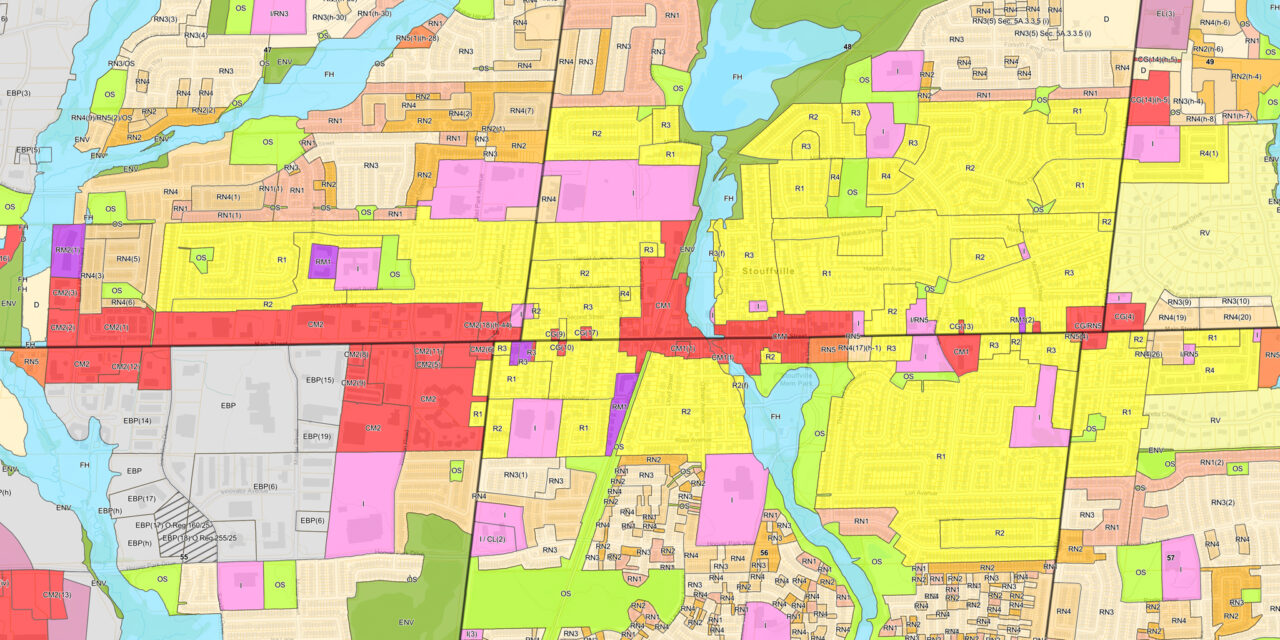
Cover image taken from Stouffville’s Interactive Zoning Map