- Ontario’s Minister of Municipal Affairs and Housing has approved a Minister’s Zoning Order (MZO) for Mon Sheong Foundation’s vacant 176 Sandiford Dr. property.
- It allows for buildings up to 70 metres tall, except for a portion near Hoover Park Dr., where the limit remains 41 metres.
- The order permits full residential apartments, upzoning the lands previously approved for institutional seniors housing.
- The MZO also cut the required resident parking rate by 70 percent.
- Mayor Iain Lovatt endorsed the MZO and has cited a 2019 Council decision as the key factor in converting the employment lands to residential.
- With new zoning and land-use permissions in place, the Town’s role is now limited to the site plan approval process.
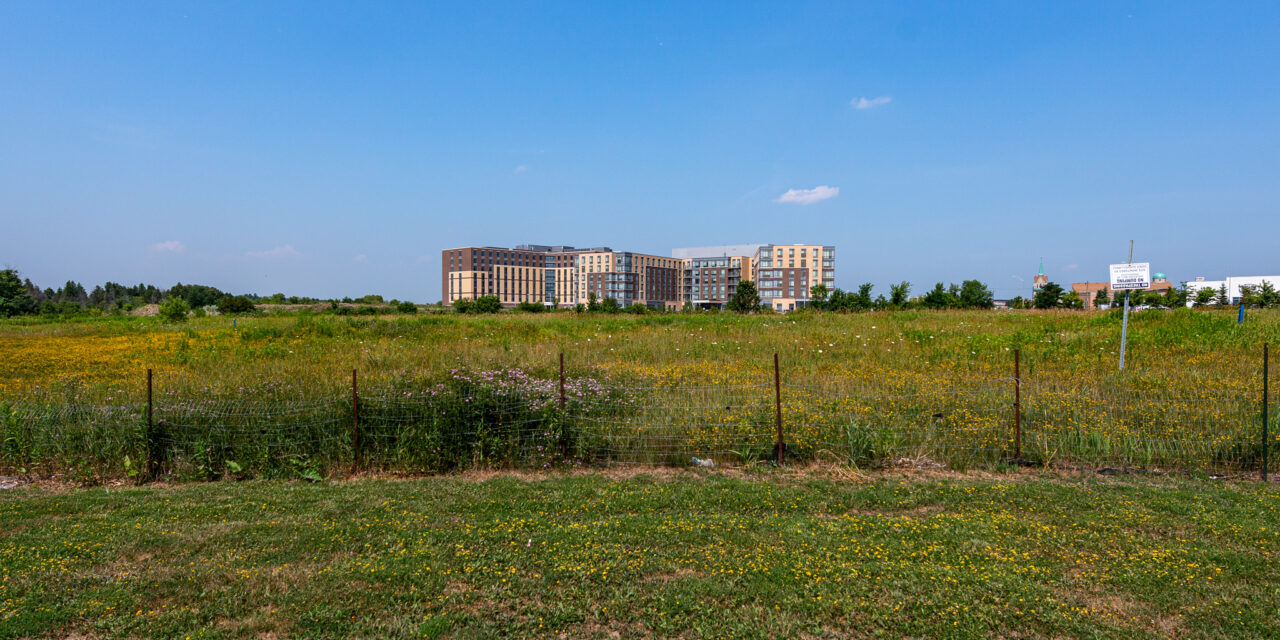
Ontario’s Ministry of Municipal Affairs and Housing has approved a controversial Minister’s Zoning Order (MZO) for the Mon Sheong Foundation’s 176 Sandiford Dr. property. The vacant site sits just south of the Foundation’s two existing long term care facilities, with frontage along both Sandiford and Hoover Park drives.
The zoning order permits Mon Sheong to build structures up to 70 metres in height throughout much of the parcel, excluding rooftop access, service, and mechanical elements. Depending on final designs, it could result in buildings of approximately 23 storeys.
In a shift from the original MZO proposal, buildings heights within 50 metres of Hoover Park Dr. will remain capped at the previous 41-metre limit.
Under zoning rules approved by Stouffville’s Council in 2019, the site was slated for two additional buildings: a 41-metre, 11-storey building to the south against Hoover Park, and a 24-metre, six storey building to the north closer to Sandiford. Combined, the developments would have delivered 658 units intended for seniors.
Those approved zoning regulations also limited cooktop facilities within individual units to no greater than 219 volts. This allowed for some independent living for residents while enabling Mon Sheong to develop assisted seniors housing under the institutional uses permitted in the parcel’s Business Park designation.
With the MZO in place, Mon Sheong can now construct complete residential apartment units with full kitchen and laundry facilities. While the initial MZO proposal suggested the site could accommodate up to 900 units, the final zoning order now in effect does not specify a maximum unit count.
Industrial, commercial, and institutional (ICI) properties generate higher property tax revenues than residential developments, making the conversion of the ICI site a top concern when the MZO was proposed. Both Council and the Town have also emphasized expanding the employment tax base to help ease the burden on existing residential taxpayers, which prompted additional criticism over the upzoning to allow for increased residential uses on the parcel.
However, it was Council’s 2019 decision that removed the Town’s ability to collect full employment-related tax revenues by permitting institutional residential uses.
Stouffville’s Comprehensive Zoning By-law requires a total of 1.5 parking spaces per apartment dwelling, which includes 0.25 visitor spaces. Under the MZO, Mon Sheong will be required to deliver just 0.5 parking spaces per unit, with 25 percent of all resulting parking spaces being designated as visitor spaces.
For the unit type, the MZO has slashed the Town’s resident parking requirement by 70 percent for the site, while cutting visitor parking requirements in half.
Rick Upton, the local councillor for the Hoover Park and Sandiford area, backed the 2019 decision to allow institutional housing, citing the need for assisted seniors living options. Since the MZO’s introduction, he has raised concerns about the increased height and density, as well as the upzoning and reduced parking requirements.
“In 2019, I voted on Council to rezone the property to institutional based on the commitment to build care beds to assist the more than 50,000 Ontarians desperately waiting for placement,” Upton told Bullet Point News. “At no point was the public properly consulted about increasing heights and switching that zoning to residential. While seniors housing is needed, the critical shortage of assisted living and long-term care beds is far more urgent.”
To meet the Minister’s intake thresholds, Mayor Iain Lovatt personally endorsed the MZO over a Council resolution—an authority only available to mayors who have been granted Strong Mayor Powers.
Lovatt has defended his endorsement, highlighting the growing need for seniors housing in Stouffville and repeatedly pointing to the 2019 decision as the decisive factor in effectively converting the employment lands to residential. He has said that if that proposal were presented today, he would not support it.
With new land-use and zoning regulations put in place through the MZO, the Town is left with the site plan approval process. That process allows Town Staff to review limited development elements such as loading and parking facilities, landscaping, grading, and servicing, the Town’s website explains.
As reported in January, Mon Sheong Board Chairman Tim Kwan said the Foundation was considering one life lease building and another dedicated to affordable rentals, both for seniors. The affordable units would require supportive construction financing from the Canada Mortgage and Housing Corporation, and would otherwise be offered at market rates without it.
The Foundation was also exploring a third, smaller long-term care facility on the property. Then envisioned as an eight-storey structure, it could provide about 190 additional LTC units. Kwan was not available for comment before deadline, but with the Minister’s zoning parameters now in place, Mon Sheong will have further opportunity to reassess its plans.