- Stouffville Council approved a zoning amendment for Darul Khair Centre’s proposed mosque on a one-hectare portion of 12662 Tenth Line on Oct. 14.
- The new Institutional zoning permits the mosque largely as designed, leaving site plan review to settle details such as servicing, access, parking layout, and lighting.
- Seven residents deputed against the application, citing traffic, parking, safety, and outstanding studies, with most stressing their concerns were not about faith.
- Staff identified no capacity concern on Tenth Line, and the parcel had been held for future urban growth.
- Councillors Richard Bartley and Keith Acton opposed the rezoning after their motion to defer the decision until a detailed traffic study is complete failed.
- At Mayor Iain Lovatt’s urging, Council directed Staff to bring the future site plan application to Council for approval.
- Ontario’s Planning Act requires the approval itself to rest with staff, leaving Council room only to endorse it.
- If a complete site plan application isn’t approved within 60 days, the applicant can appeal to the Ontario Land Tribunal, where a provincial adjudicator would decide.
Stouffville Council approved the zoning needed for Darul Khair Centre’s proposed mosque at 12662 Tenth Line during an Oct. 14 special meeting. It then voted to pull the project’s site plan approval, the next step in the planning process, back to Council Chambers.
Councillors framed the added step as another chance for residents to weigh in. However, while a site plan application can return to Council for an endorsement, Ontario’s Planning Act requires councils to delegate the approval itself to municipal staff.
It also sets a 60-day clock: if a complete application isn’t approved in that time, the applicant can appeal to the Ontario Land Tribunal (OLT).
Site plan review is a technical process that is “not meant as a means to revisit the principle of development,” according to a recent Provincial bulletin. “Allowable land uses, height, density, setbacks, and other matters pertaining to built form would already have been addressed at the zoning stage and should be considered as of right,” it adds.
“As of right” refers to a use or built form the zoning already permits, needing no further approval in principle. With the parcel moved out of Development Reserve and into Institutional zoning, the mosque Darul Khair Centre proposed is now permitted largely as designed.
The rezoning required no exceptions to the standard Institutional zone, meaning the building’s roughly 2,800 square metres, its 8.5-metre height and 11.75-metre minarets, and its 168 parking spaces, 39 more than required, already fit the zone’s rules.
Site plan review can still shape details such as servicing, access, parking layout, lighting, and landscaping. It cannot be used to further limit the building’s height or size, force more parking, or reopen whether the use is allowed.
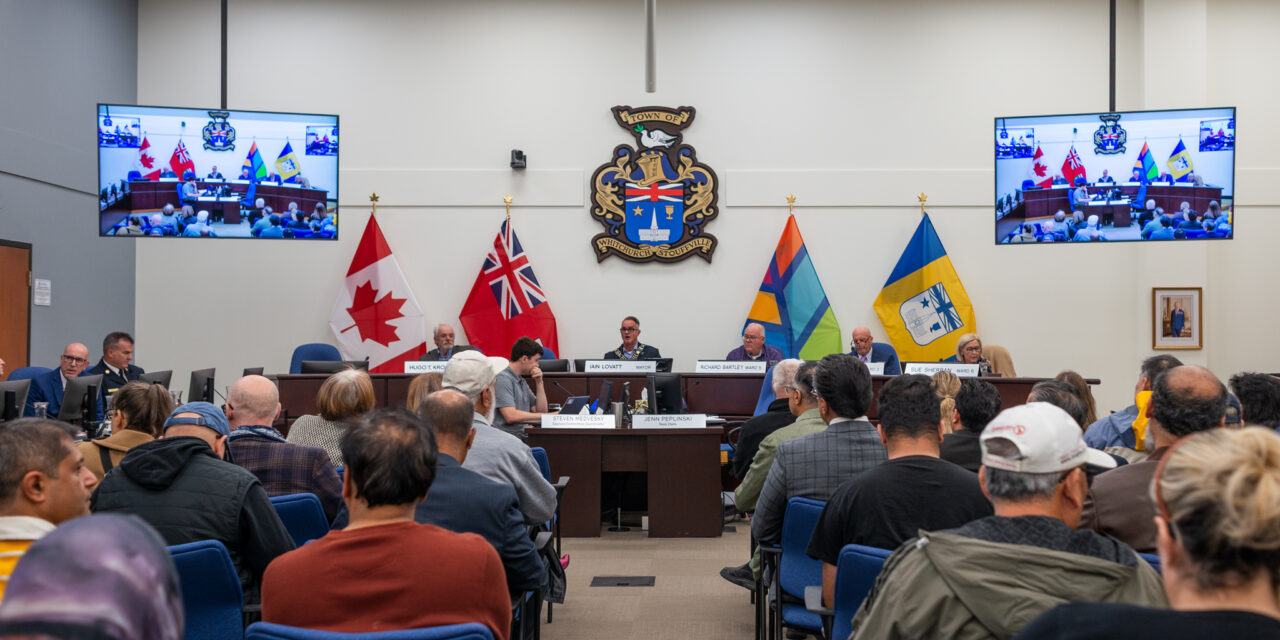
The rezoning passed 5–2 following a tense afternoon in Council Chambers, where seven residents deputed against the application and an attempt to defer the decision failed.
The agenda item then closed on a concerning note. After a brief recess, Mayor Iain Lovatt condemned what he called “a clear declaration of Islamophobia” directed at a member of the Muslim community in the meeting’s overflow room.
The Site Council Asked For
Tenth Line is the second site Darul Khair Centre has brought to the Town. In May, Council refused its smaller proposal at 27 Winona Dr. in a 4–1 vote, despite Town Staff recommending approval, and encouraged the Centre to keep working with Staff on an alternate site.
The Tenth Line site emerged through mediation after the Centre appealed that refusal to the OLT. The Winona appeal remains in mediation, holding off a hearing in which Town Staff, having recommended approval, could not defend Council’s refusal.
Should progress on the new site stall, Darul Khair Centre could push that appeal to a hearing, where Council’s refusal would stand against its own Staff’s recommendation.
The one-hectare parcel does not immediately abut the Forsyth Farms neighbourhood, and Staff concluded the development “can be accommodated” within planned transportation and infrastructure improvements.
Seven Deputants, One Request
Each deputant asked Council to delay or refuse the rezoning, citing traffic, parking, noise, pedestrian safety, and studies that have yet to be completed. Most stressed their concerns were about the site, not the faith.
“Everyone has the right to worship, and I have no objection to any faith,” said Lucia Ko, who lives near the property.
“Rezoning is easy to approve, but nearly impossible to undo,” said Mark Mickovski, who also questioned whether the site is “appropriate” for a development of such scale.
At about 2,800 square metres, the mosque would be smaller than several places of worship the Town has approved over the past two decades. They include East Ridge Missionary Church, a 4,736-square-metre facility that Councillor Sue Sherban noted is “just down the street.”
Kasia Kania called the proposal “fundamentally out of step with the low density agricultural landscape of Tenth Line,” which she said people “have moved away from big cities to enjoy.”
The parcel of land is farmed today, but its former Development Reserve zoning was meant to serve as a holding category for future urban growth.
“Just because it’s used for agriculture does not make it agricultural land,” Ward 1 Councillor Hugo Kroon said later, adding that without an institution, the site would likely hold “a couple of hundred more homes, with all the resultant sort of traffic issues and congestion and noise and lighting.”
The Town expects the nearby Old Elm GO station area alone to hold as many as 15,000 residents at full build-out, which is a result of its designation as a planned Major Transit Station Area.
“I hate to be the bearer of bad news, but there’s a whole lot of growth coming here,” Lovatt said.
Dali Wang, who said she uses Tenth Line every day, pressed Council on children’s safety, setting the traffic brief’s estimate of 563 vehicle trips in the Friday midday peak hour against the site’s 168 parking spaces.
“If your decision is wrong, the price will not be another traffic report,” she said. “It could be a child’s life, and an apology will never bring that child home.”
The 563-trip figure counts vehicles both arriving and leaving, and Staff identified no capacity concern on Tenth Line. The road is designated an arterial, and the Town expects it to carry fewer than 7,500 vehicles a day near the site by 2051. That is less than half the 15,000 trips most Town arterials are projected to see by that time.
Planned improvements in the early 2030s are intended to “ensure adequate transportation capacity for existing and future development.”
While site-specific servicing details will still need to be addressed, allocation is not a concern. Some concerns are well founded, however. Tenth Line has no sidewalks today, its urbanization upgrades are years away, and the full traffic and noise studies do remain outstanding.
But those outstanding studies are required at the site plan stage, not the zoning stage. Even Councillor Keith Acton, who later seconded a motion to defer, acknowledged the detailed traffic study “normally… comes at site plan approval.”
Deputant Eddie Ng noted that at Winona, the Town peer reviewed a full traffic impact study before Council decided on the zoning application, which Staff supported. Council still refused the application.
A Promise of Another Say
Councillor Richard Bartley moved to defer the decision until the traffic study is complete and reviewed by Staff. “As they say, the people have spoken, and they’ve spoken loud and clear,” he said, adding that he had met with about 60 residents in a park over the Thanksgiving weekend.
Acton seconded the motion, saying Ward 3 residents “feel we’re making decisions on assumptions.”
In May, Bartley and Acton were among the four Councillors who voted against deferring the Winona decision before refusing it. This time, the deferral failed with only their support.
Lovatt agreed concerns about traffic, parking, noise, and servicing are important, but said the Planning Act sets the order in which they are addressed. “There is a planning process, and the Planning Act actually dictates that process, and we have to follow it and respect it,” he said, warning that setting it aside could land the Town “at the OLT again.”
He then introduced an amendment directing Staff to bring the future site plan application to Council “for Council’s consideration and approval.” That would occur before plans are approved and a site plan agreement is signed. Kroon moved it, and Sherban seconded.
The amendment, Lovatt told the room, “ensures and enshrines with Council’s direction… that all of your concerns are going to be dealt with.”
“Because site plan is delegated to Staff, this could have ended here,” he further explained. “We are pulling that back to give residents in the community the ability to vet and review all the studies.”
Bartley asked whether residents would be able to “speak and comment” when the application returns to the Council table. “Any member of the public can speak to any item on the agenda… so yes, it would be my assumption that that would absolutely be the case,” Lovatt replied.
Kroon asked whether the Planning Act allows Council to take that step. Commissioner of Development Services Dwayne Tapp told Council it can ask that controversial site plan applications “come to Council and not through Staff,” with Staff still presenting their review, agency comments, study results, and a recommendation.
Satisfied, Kroon called the amendment “an important step that we give the public another opportunity to be involved in [the] process.”
While nothing appears to prohibit a site plan application from coming to Council for an endorsement, the Planning Act now mandates municipalities with by-laws requiring site plan control to appoint “an officer, employee, or agent of the municipality” to approve site plans. In Stouffville, that authority has been delegated to Tapp.
In the Province’s words, site plan decisions are now made by Staff “instead of municipal councils or committees of council.” It adds that “a site plan approval is not a public process,” with no “public notification, public meeting, or hearing requirements.”
That gap surfaced when resident David Slimowitz interrupted proceedings before the vote. Allowed to speak by Lovatt, he asked whether residents could return “and debate that clause,” appearing to refer to the zoning change or the development generally.
Lovatt clarified: “We’re not going to be back here to debate the clause. You’ll be back here with all the information that you’re requesting we wait to get before we make a zoning decision.”
In practice, the studies residents asked for will arrive the way they normally do: through site plan control. The difference is that the application will come before the public on a Council agenda, which Council can endorse or not, but approval still rests with Town Staff.
Lovatt’s amendment passed unanimously. Acton said he could not support the zoning without the deferral, but was “happy that it’s coming back to Council.” The amended motion then carried 5–2, with Bartley and Acton opposed.
Looking Ahead
Darul Khair Centre must next apply to the Committee of Adjustment to sever the one-hectare parcel, then submit its site plan application. Under Council’s direction, that site plan will now come back to a new Council, whose term begins Nov. 15.
Whoever sits at the table won’t be able to revisit the zoning approved Oct. 14, or whether a mosque belongs on the land.
Town Staff must still be satisfied the plans meet municipal requirements, including a full traffic impact study, servicing modelling, and noise and lighting controls. If Council tries to slow the project at that stage, the 60-day clock still applies, and the Centre could take its Tenth Line application to the OLT.
All the while, the Winona appeal sits paused in mediation.
If Tenth Line stalls, Darul Khair Centre could ask the OLT to move that appeal to a hearing, where Council would have to defend its refusal without its own planning Staff, who recommended approval and cannot argue against it.