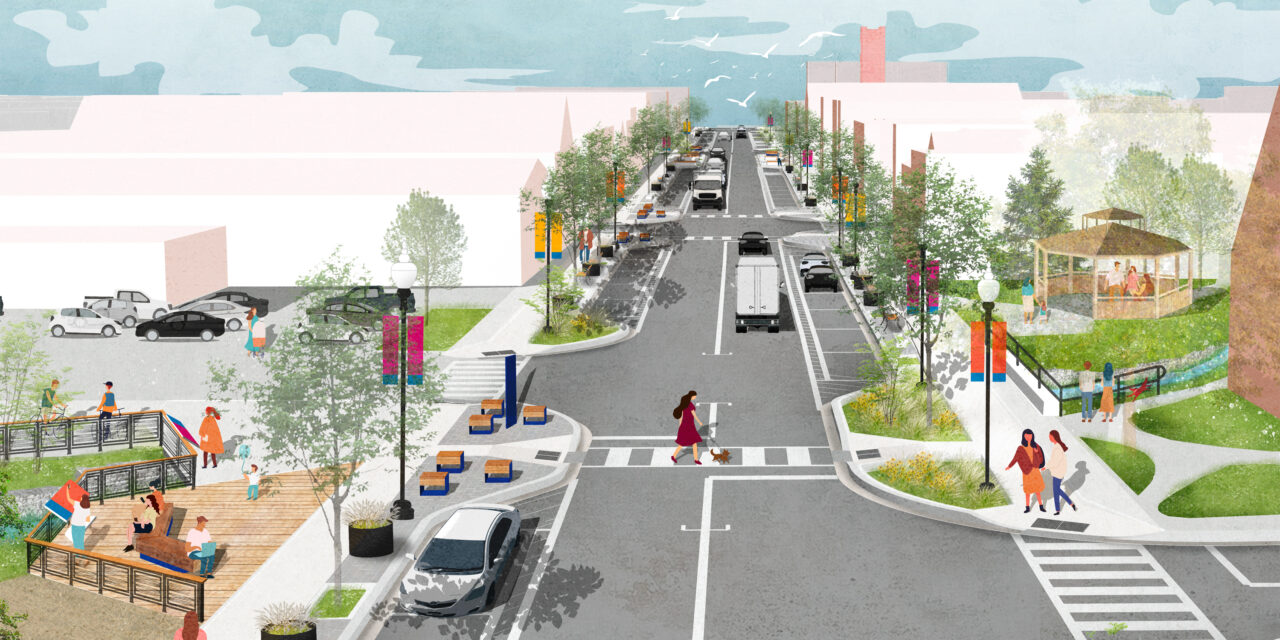
- Stouffville’s Main Street reconstruction will replace aging underground infrastructure while revitalizing the town’s historic downtown.
- Updated plans for the Village area were presented during a Jan. 29 public open house.
- On-street parking has been largely restored to 76 spaces, up from 42, and additional parking options are under review.
- Roadway changes include restricted access at Blake Street and revised pedestrian crossings.
- Construction is expected to begin in late 2026, span multiple seasons, and be phased to avoid full road closures.
- Town Staff emphasized early communication and maintaining pedestrian access to adjacent properties during construction.
- Financial compensation will not be offered to impacted businesses, though temporary relief from the Village’s special tax levy is being considered.
Stouffville’s long-awaited Main Street reconstruction project is in its most complex and consequential stage, with Town Staff and consultants Accardi Engineering outlining how major infrastructure upgrades and Downtown revitalization will unfold at a recent public meeting.
The broader project is being delivered in three phases. Phase 1, spanning Stouffer Street to Park Drive, was completed in 2018. The current Phase 2 covers Park Drive to Edward Street, and a future Phase 3 will extend improvements east from Edward Street to Ninth Line.
The Jan. 29 public open house at 19 on the Park included Capital Projects Manager Mandy Paglia, who described Phase 2 as the most challenging portion of the overall initiative. She joined Accardi Manager of Project Delivery Nicholas Bellissimo in presenting updated plans and addressing concerns from both residents and business owners.
“We will be replacing underground services, including storm sewers, sanitary sewers, and water mains, along with full road reconstruction,” Paglia said. “Streetscaping will also be implemented to improve accessibility and beautify the corridor.”
Bellissimo cited deteriorating underground infrastructure as a key driver of the project. “Several municipal systems along the section of Main Street require renewal due to their current condition, as well as to meet future servicing needs,” he said.
The project will support future growth by ensuring Main Street’s infrastructure can accommodate demand stemming from planned intensification in the area. Overall improvements are also expected to position the corridor to better serve residents, businesses, and visitors as the community continues to grow.
“Completing these infrastructure upgrades as part of this revitalization project reduces long-term risk and improves overall system performance,” Bellissimo said, noting the coordinated approach avoids future disruptions by aligning needed underground and surface work.
Parking, Pedestrians & Traffic Flow
Parking on Main Street has been a central concern throughout the Town’s consultation processes. The reconstruction project’s 30 percent design, presented in June 2025, included features such as bus lanes and bump-outs that reduced on-street parking from 82 to 42 spaces. Following public feedback, the design was revised.
“We revised curb bump-out locations and updated bus stop locations to improve transit operations and reduce conflict between vehicles, transit, and pedestrians,” Bellissimo said. The updated design restores on-street parking to 76 spaces “while still prioritizing safety, accessibility, and overall function.”
Pedestrian crossings remain at most intersections. However, a crossing previously planned west of Church Street has been removed from the design. Another crossing, not included at the 30 percent stage, was added east of O’Brien.
Additional traffic counts have informed the design of signals and pedestrian crossings. “Because the corridor is constrained, the design focus is on safe, predictable movement, and improving pedestrian safety where people cross most often,” Bellissimo said.
Mayor Iain Lovatt said the Town is also pursuing other parking solutions, including discussions with Main Street property owners who may have rear-lot space suitable for public use. Those spaces could support businesses during construction and potentially remain afterward. He also pointed to existing municipal lots.
“There is parking that is available, the challenge people have is that they don’t want to walk the 50 metres from this parking lot to your store,” Lovatt said in response to a question. “We’re only losing six [Main Street] spaces, because I know that was a big comment that we heard. But we are going to look for additional parking areas.”
Given safety concerns regarding its close proximity to the Stouffville GO rail corridor, access to Blake Street will be heavily restricted. The new design only allows for right-in access from Main Street, and there will be no access from Blake back onto Main.
Edward Street, which was recently reconstructed, is expected to serve as a primary detour route. Other detours may also be developed with the selected contractor once phasing is finalized, Paglia said.
Streetscape & Design Features
“The design works to provide a comfortable downtown experience that encourages both walking and gathering,” Bellissimo said, noting that the goal is to “preserve character while adding modern functional features.”
Plans include new seating and meeting spaces, opportunities for public art and future trail connections, upgraded lighting, improved drainage, and landscaped curb bump-outs that help manage stormwater.
“Bioretention features will be constructed within the bump-outs,” Bellissimo said, explaining that runoff will be directed into planted areas using native vegetation to filter water and enhance the streetscape.
Bellissimo also addressed the Stouffville Creek culvert beneath Main Street, noting that Accardi worked with the Toronto and Region Conservation Authority to assess it and its capacity. While culvert replacement can be disruptive, as seen during work at Highway 48 and Stouffville Road, testing under “various rainfall intensities” confirmed the structure meets regulatory requirements.
“This confirmation allows the project to focus on the underground infrastructure and streetscaping improvements rather than introducing additional culvert replacement work,” Bellissimo said.
Construction Phasing
Construction is planned to begin in late 2026 to avoid disrupting the Downtown during summer months. It is expected to span multiple construction seasons, and a four-stage approach is being explored to avoid the full closure of Main Street.
A preliminary staging map presented during the meeting suggests progress will move east to west, beginning between Park Drive and Mill Street, followed by Market Street to beyond Lloyd Street, then to the rail tracks, and finally from the tracks to Edward Street.
However, Paglia cautioned that sequencing is not finalized. “We’re going to be working with the contractor to determine what [phase] goes first,” she said. “I think we have our visualization of how it goes…[but] it may or may not work out that way.”
The Town expects to launch a prequalification process in the spring to help refine the vendor pool, followed by a formal tender in late summer. If all goes to plan, a contract award is anticipated by September or October.
Addressing Business Concerns
“ Maintaining access to local businesses is a key consideration, and we are continuing to investigate how customer access, deliveries, and essential services can be supported during each stage,” Bellissimo said. “The overall approach to construction is built around planning, coordination, and communication… Our goal is to keep everyone safe, informed, and moving while the work progresses.”
Several business owners emphasized the need for early and clear communication. Redefined Finds owner Alison Jackson said advance notice is critical for planning inventory and staffing. “For a retailer, you’re ordering Christmas now,” she said. “So if the street is going to be closed at Christmas, it affects our business.”
Paglia said the Town would provide as much notice as possible, but the contractor will ultimately play a key role in establishing firm timelines.
“If they have a better suggestion in terms of how they think this work can progress, we’re going to listen, just like we’re listening to you,” explained Director of Engineering and Public Works Jack Graziosi. He also said that underground work should not limit pedestrian access to stores.
Questions were also raised about financial support for impacted businesses. Amanda Black, co-owner of Francis & Meyer Candle Co. and recent winner of the Stouffville Small Business Challenge, asked whether subsidies would be available given the uncertainty created by the project.
“This is very exciting, yet extremely discouraging,” Black said, noting the challenge of committing to a three-year lease with construction looming. “That’s a big decision that we need to make as a business, and… I just want to know if there’s been any thought put towards how the businesses on Main Street can be supported.”
Mayor Lovatt responded, saying the Town would not provide direct financial compensation. “We can’t take that tax burden on as a municipality, to subsidize businesses,” he said.
However, Lovatt suggested temporary relief from the Village’s special tax levy could be considered. “The Village Advisory Committee will be discussing…to see about putting that on pause during the construction,” he said, adding that it could then be implemented after.
What Comes Next
Feedback from the open house will continue to inform Accardi’s final design, and comments can still be provided online. A fourth public open house is planned for the pre-construction phase, expected this spring or summer.
“This is one of the biggest projects Stouffville has ever done,” Corporate Communications Manager Glenn Jackson said in closing remarks. “But it’s one of the most exciting ones, and the outcome at the end of this project is going to be amazing.”
Cover image provided by and used with permission from the Town of Whitchurch-Stouffville