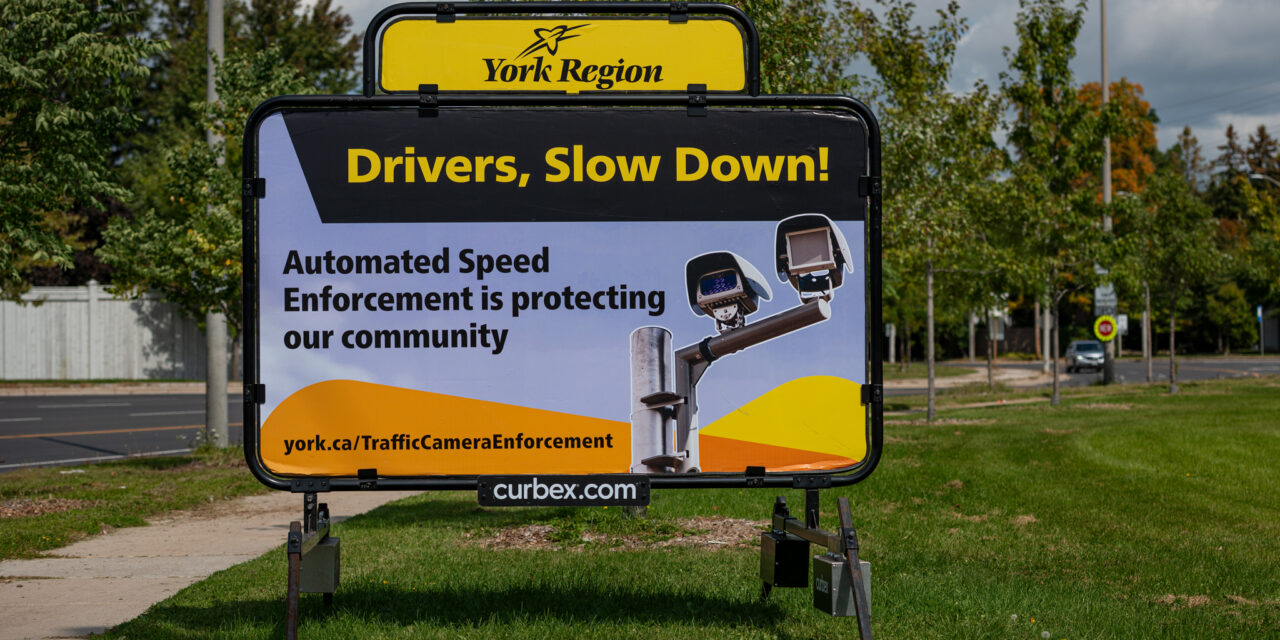
- Premier Doug Ford has threatened to remove automated speed enforcement (ASE) cameras throughout Ontario, calling them a tax grab.
- York Regional Police offered support for York Region’s ASE program during a recent presentation, saying it boosts safety and frees officers to address other crimes.
- York Region data shows collisions down 53% from forecasts as the number of tickets being issued declines.
- Stouffville Mayor Iain Lovatt said the Town may consider changes to its ASE program next month.
- Regional Mayors and Councillors offered support for ASE, with some open to reforms in collaboration with the Province to prevent its dismantling.
- The Association of Municipalities of Ontario has advocated for municipal decision-making regarding ASE, warning that speeding returns when ASE cameras are removed.
Premier Doug Ford has reignited debate over automated speed enforcement (ASE) programs, threatening to scrap the cameras through legislative changes if municipalities refuse to voluntarily remove them. Calling the systems “nothing but a tax grab,” Ford said last week that municipalities should “take out those cameras, all of them.”
Ontario’s Ministry of Transportation echoed the sentiment in a recent statement to CTV News, describing ASE as “a cash grab” and pledging that the government is exploring alternative road safety tools. “We want to see cities take steps to remove them, otherwise we are prepared to help get rid of them when the House returns in the fall,” said Dakota Brasier, spokesperson for Transportation Minister Prabmeet Sarkaria.
Ford’s stance has gained traction among York Region residents who see the cameras as punitive cash grabs rather than the safety tools municipalities claim. Yet many local leaders, police officials, and traffic experts are pushing back, presenting data that suggests ASE programs are improving compliance, reducing collisions, and saving lives.
York Regional Police Back Cameras
During York Regional Council’s Thursday meeting, York Regional Police Constable Todd Snooks explained how ASE has become an essential tool for both road safety efforts and policing priorities.
“York Regional Police is fully supportive of the Automated Speed Enforcement program,” Snooks said. “The data, the science, and the extensive research…surrounding survival rates for humans struck by vehicles should be the focus.”
He noted that the cameras free up officers to concentrate on other serious public safety concerns. “Programs like ASE provide officers more time and resources to focus on other critical areas of policing, including other known road safety needs,” Snooks said.
He emphasized that the combination of unsafe speeds, vulnerable road users, and increasingly dense road networks remains a central safety issue. “Our collaborative and proven effective efforts and programs established through [York Region’s] Traveler Safety Plan and [YRP’s] strategy are key steps in the right direction to addressing this challenge and should not be abandoned,” Snooks said.
Data Shows Measurable Results
Regional Staff also presented new data detailing ASE’s effectiveness. Nelson Costa, York Region’s Manager of Traffic Safety and Signal Operations, told Council that “daily collisions are trending to be 53 percent lower than forecasted, and speed compliance is 25 percent higher” where cameras have been installed.
He also highlighted a striking behavioural trend: “We’ve seen a 35 percent decrease in penalty orders issued [since January 2025], meaning drivers are starting to get the message, and they’re slowing down.”
Costa highlighted research from the Canadian Association of Road Safety Professionals, which found that lowering vehicle speed from 50 km/h to 30 km/h reduces the probability of a pedestrian fatality from roughly 80 percent to 10 percent. “Driving 10 kilometers per hour less through a school zone will add about eight seconds of travel, but will potentially save a life,” he said.
“It’s just science,” Richmond Hill Mayor David West commented. “The more energy that’s in a vehicle, the more damage it’s going to do to whatever it hits.”
Mayor Lovatt Focuses on ‘Real and Immediate Results’
Stouffville Mayor Iain Lovatt said ASE has made an undeniable difference.
“Automated Speed Enforcement in Stouffville has proven to be the one traffic calming tool that delivers real and immediate results in slowing down traffic and protecting pedestrians and cyclists,” Lovatt told Bullet Point News.
He added that the Town would respect Provincial direction if sweeping changes come. “It is hard to dispute the hard data, but if the Province decides to eliminate ASE in its totality, standardize the program, or legislate changes, we will of course follow their direction.”
Asked if Stouffville intends to maintain its program until possible legislative changes come forward later this year, Lovatt said Council may revisit aspects of the Town’s program when Staff deliver a mid-year ASE report in early October.
Calls for Reform, Not Elimination
Multiple Regional Councillors highlighted speeding and road safety as a leading concern from their residents. “ The number one complaint that I’ve received in the almost 28 years I’ve been on municipal council is speed on streets, safety on the roads,” Georgina Mayor Margaret Quirk said.
The debate has already produced different responses among municipalities. While some have not implemented their own program, Vaughan Mayor Steven Del Duca has paused ASE in his city following resident complaints. He recommended that York Region avoid committing any additional funds to the program until more clarity is available from Queen’s Park.
However, some York Region mayors signaled openness to reforms, such as clearer signage or program adjustments, rather than dismantling the system entirely. Newmarket Mayor John Taylor framed the moment as an opportunity for dialogue with the Province.
“The Premier has expressed concerns about the program. That’s great. Then let’s have a conversation,” he said. “I’ve reached out to the Premier and said I’m willing to sit down and talk about ways that we could have legislative changes to reform or restrain automated speed enforcement in the areas he’s concerned about.”
Taylor emphasized the cameras’ impact on both traffic and policing resources. “We know it works. It frees up police time to work on things like…home invasions and auto theft. Anybody who drives down streets that have automated speed enforcement knows the traffic is slowed, and it’s starting to spread to streets that don’t have [cameras].”
AMO Pushes Back
The Association of Municipalities of Ontario (AMO) has also come out in defence of ASE. In a Sept. 10 letter to Premier Ford, AMO President Robin Jones warned that removing the cameras would undermine safety.
“Speed limits are legal requirements, and enforcement of the law is not a cash grab or a tax,” Jones wrote. “Net ASE revenues are reinvested in community safety improvements and mean that police officers can focus on other higher-impact activities.”
She added that municipalities are best positioned to make decisions based on local needs, and that a recent survey from CAA South Central Ontario shows nearly three-quarters of Ontarians support the cameras. “Municipalities understand the need to use these tools thoughtfully and can be counted on to do so,” Jones wrote, warning that when ASE cameras are removed, speeding returns to community streets.
“Yes, people say it’s a cash grab… So let’s reform the program and address some of those concerns,” Taylor said during the Regional Council meeting. “This is our opportunity, and it shouldn’t be lost to actually address the number one complaint [we’ve heard] for decades.”