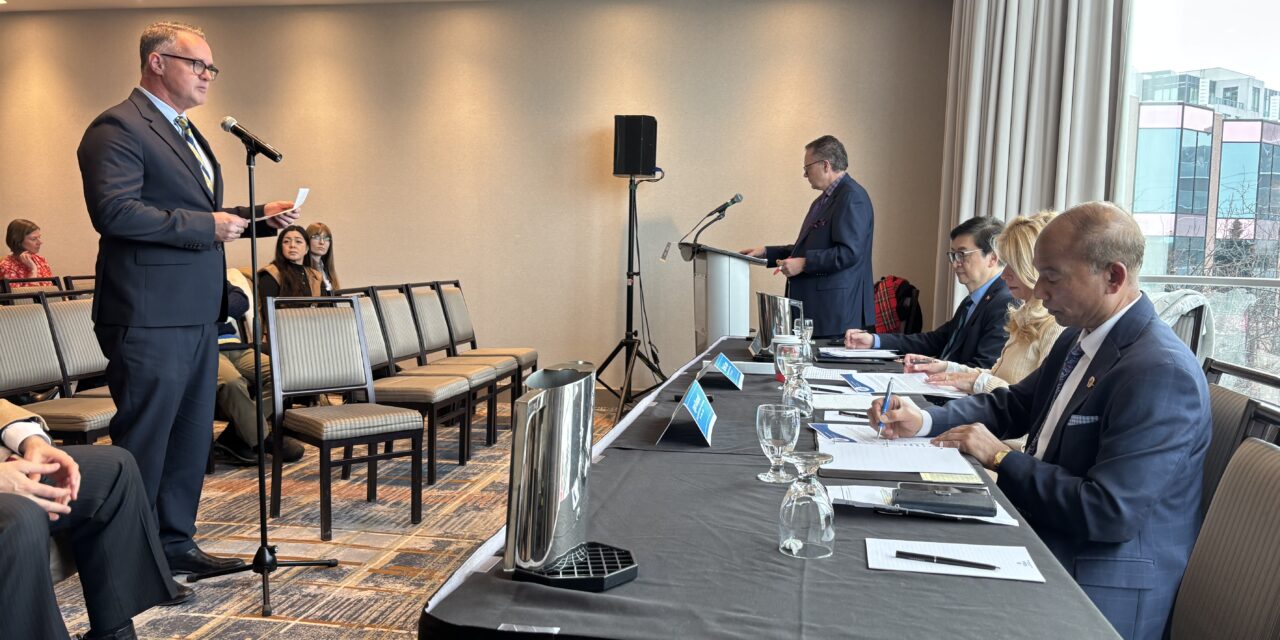
- Stouffville Mayor Iain Lovatt presented on behalf of the Town as part of a consultation session for the 2026 Ontario Budget.
- He called for improved funding models to help expanding municipalities manage growth-related pressures.
- Rising construction and labour costs are forcing the Town to defer or cancel infrastructure projects needed to support population growth.
- The Town also faces a $14.6 million asset management funding gap, alongside rising service expectations from existing residents.
- The Mayor renewed the Town’s call to allow development within protected conservation lands along Highway 404.
Stouffville Mayor Iain Lovatt appeared before MPP and Parliamentary Assistant to the Minister of Finance Michelle Cooper yesterday, submitting comments on behalf of the Town as part of consultations for the 2026 Ontario Budget.
His deputation emphasized the need for increased and consistent provincial funding, while outlining the fiscal pressures currently facing fast-growing municipalities.
As Stouffville works to meet provincially assigned housing targets, Lovatt pointed to the Town’s rapid population growth and the mounting financial demands that accompany it. Those pressures, he said, cannot be managed by municipalities alone if they are to support provincial housing and economic objectives.
“Our message to you today is simple and urgent: small, fast-growing GTHA municipalities need permanent, stable, and predictable funding,” Lovatt said. “Without it, the communities driving Ontario’s growth will be unable to keep pace with the responsibilities placed upon them.”
The Mayor noted that the Town’s primary revenue source is structurally limited, with Stouffville able to retain just 34 cents of every property tax dollar collected. At the same time, efforts to limit tax increases are complicated by inflating costs tied to major budget drivers, including wages and construction, alongside the need to expand services and infrastructure to keep pace with growth.
“With construction inflation among the highest in the country, our dollars no longer stretch far enough,” Lovatt warned. “We are deferring or cancelling infrastructure projects that our growing population urgently needs.”
He also highlighted rising costs associated with maintaining existing services and capital assets. Residents, he said, increasingly expect “modernization, digital access, strong cybersecurity, and accessible services,” while smaller municipalities face reduced purchasing power.
Stouffville is grappling with a $14.6 million annual funding gap identified through its asset management plan, which is mandated by the Province and outlines the long-term costs required to maintain, repair, and replace aging municipal assets. The shortfall can result in the deferral of renewals, affecting both core infrastructure such as roads and facilities, as well as assets such as the Town’s vehicle fleet.
To help address these challenges, Lovatt called for enhancements and expanded access to the Ontario Municipal Partnership Fund and the Ontario Community Infrastructure Fund. Together, they provide hundreds of millions in unconditional and infrastructure-related funding to smaller and more rural municipalities each year.
“Municipalities need permanent funding streams indexed to construction inflation or CPI so we can plan responsibly, tender competitively, and deliver infrastructure on time and on budget,” he said.
Lovatt concluded by reiterating the Town’s request for development access within protected lands along Highway 404. He argued the move would unlock significant employment opportunities and better balance Stouffville’s tax base, which currently sits at approximately 90 percent residential and 10 percent commercial.
Describing the existing land-use rules as “restrictive,” he said the Oak Ridges Moraine Countryside Area designation has effectively rendered the lands a “stranded provincial asset.”
“Unlocking this corridor for industrial and commercial development would provide thousands of jobs, a more balanced tax base reducing these mentioned pressures, and long-term revenue stability—benefiting both the Town and Ontario’s broader economy,” Lovatt added.
In a follow-up interview with Bullet Point News, the Mayor expanded on what he described as a growing fiscal imbalance between municipalities and higher levels of government. As local economies strengthen, revenues from sources such as HST and income tax increase at the provincial and federal levels. Those gains, he said, are not flowing back to municipalities in a proportional way.
“We haven’t seen a tax increase in Ontario since Premier Ford took office, which he attributes to general economic growth happening within the province,” Lovatt explained. “That leads to greater tax dollars and revenues being collected by higher levels of government, but proportionally, we don’t see that reflected in funding models for municipalities.”
Lovatt said relying more heavily on property taxes to offset that gap is “completely unsustainable,” arguing that both the provincial and federal governments need to “carve out funding that reflects the economic vitality of growing municipalities.”
In the meantime, he pointed to an increasing dependence on one-time funding programs, which are often overwhelmed with responses and unable to meet demand from municipalities, as a source of ongoing uncertainty.
Stouffville applied last year for $12 million through Ontario’s Housing-Enabling Water Systems Fund for Main Street reconstruction, hoping to offset the costs of major water infrastructure replacement tied to future growth in the Stouffville GO Major Transit Station Area. The infrastructure work represents a significant portion of the project’s overall $22 million price tag and is considered critical to enabling future intensification.
“We were denied. For our two most recent infrastructure grant requests, we received letters explaining that the programs were oversubscribed and demand far exceeded available resources, and I really don’t want to hear that anymore,” Lovatt said. “They are also all or nothing. I would have been grateful for $3 million for Main Street, but instead we got nothing.”
Lovatt pointed to other capital projects that have been deferred as a result of budget constraints, including the reconstruction of Edward Street, which has since been completed, as well as this year’s planned work on Winona Drive and McKean Park.
Despite the challenges, Lovatt said coordinated action by senior levels of government could “unlock real change within municipalities across the country.” While also acknowledging there has been limited movement on these concerns to date, he said he remains “hopeful” the Ontario government will shift its approach.
With respect to Oak Ridges Moraine lands within Stouffville’s Highway 404 corridor, Lovatt said the Town has been directed to raise its concerns through scheduled conservation plan reviews, including the upcoming 10-year Greenbelt review, which periodically reassesses land-use policies across protected areas.
“There will be a formal process, and when a consultation opportunity comes up, I’ll be there to present our case,” Lovatt said. “Our pitch will not be to remove anything from the Greenbelt or the Oak Ridges Moraine, but instead download some responsibilities and land-use decision making to local municipalities.”
Under that approach, Lovatt said local control would apply to countryside lands only, adding, “I’m committed to protecting the natural linkages in the core areas of the plan.”
Cover image provided by and used with permission from the Office of the Mayor.