- Last week’s public planning meeting presented draft zoning changes aimed at increasing density and reducing parking requirements.
- Lower parking minimums would lessen barriers to new housing as living patterns change, Town Staff say.
- Members of Council questioned whether the proposed reductions are appropriate for Stouffville.
- Councillor Sherban said permitted on-street parking may be needed to accommodate added density.
- A final recommendation report on the proposed zoning and parking changes is expected in the coming months.
A March 11 public planning meeting outlining proposed zoning changes to support higher-density housing quickly turned into a broader discussion about parking, car dependency, and how Stouffville may evolve in the years ahead.
While the draft amendments would also expand permissions for multiplex housing in existing neighbourhoods, Council contemplated reductions to parking requirements across several housing types, and whether the changes adequately consider realities on the ground.
Will Lamond of WSP Canada, a consultant working with the Town, acknowledged that most Stouffville residents continue to rely on personal vehicles. However, he said the broader policy direction being considered could reduce that dependence by encouraging more complete communities.
It’s about “trying to find that balance between increasing housing options and reducing housing costs on one side, and being realistic and faithful to the needs of the community on the other side,” Lamond explained.
Town Staff offered a longer-term outlook, pointing to shifting demographics and evolving living patterns. In their view, reducing parking requirements will make it easier and cheaper to build new housing.
“The way that we have lived for the past 20, 30 years won’t necessarily be the way that we live in the future,” Stouffville Senior Planner Brandon Slopack said. “We know that there are people who have different living situations, people are working from home… There are multi-generational families where the grandma and grandpa don’t drive.”
“We want jobs, we want growth,” Slopack added. “We want to evolve into a more sustainable community that travels in different ways…and increased density and critical mass in certain appropriate areas will help bring these things to light.”
Despite those goals, several members of Council questioned whether reduced parking requirements can be supported in a town that remains so car-dependent.
Councillor Sue Sherban pointed to existing parking pressures throughout the community, suggesting Stouffville may not be well-positioned for lower parking minimums. While supporting efforts to introduce more housing options, she raised concerns about how increased density and reduced parking would function without expanded transit service.
“I’m happy to hear that we are…trying to find that solution, but I think we still need some work to be done on how we can build this higher density and accommodate the car,” she said.
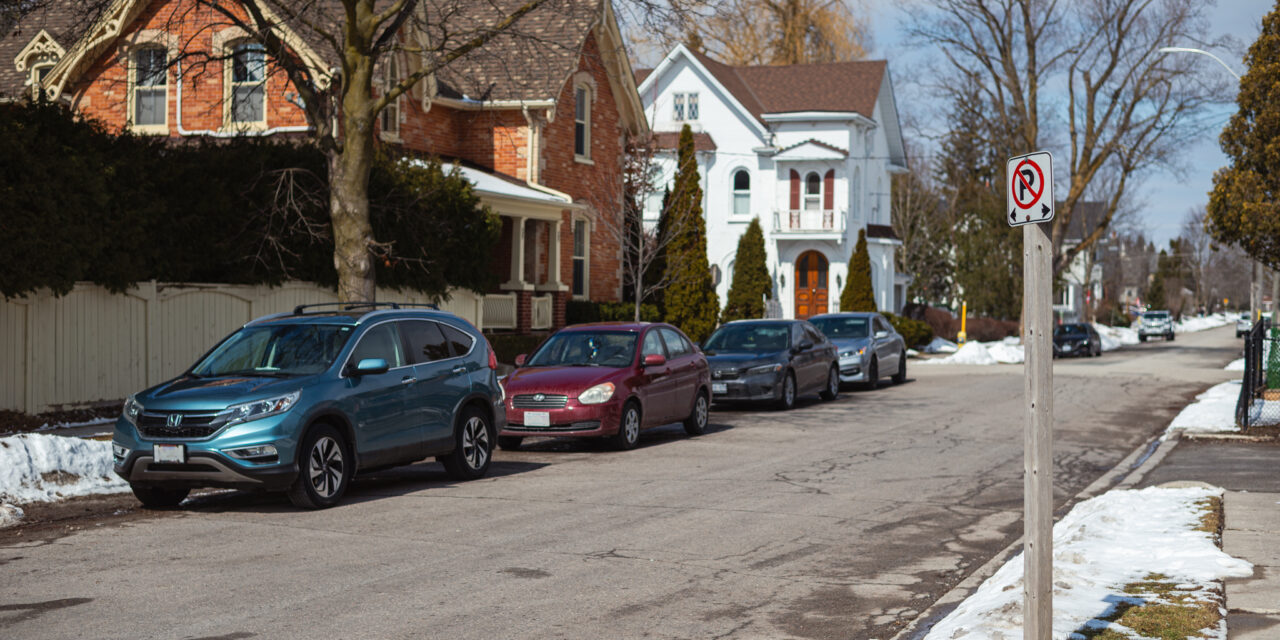
As infill development and Additional Residential Units (ARUs) become more common, Sherban suggested that introducing permitted on-street parking could help offset reduced on-site parking requirements. While acknowledging the idea may be unpopular, she framed it as a likely evolution for the Town.
“I’m sure there’s a lot of people cringing right now, because we all think our street should be empty and we should be able to look out our house and see no car blocking us, but I believe that we are going to need to go that direction,” she said.
Mayor Iain Lovatt highlighted the financial impact of parking requirements. He referenced correspondence from Nick Pileggi, an MSH Planning consultant and former Development Services Manager at the Town of East Gwillimbury, who explained that parking can significantly increase housing costs.
“Above-grade parking or below-grade parking can add anywhere from $50,000 to $100,000 to the price of a unit,” Lovatt read. “Owners will know at the time of purchase how much parking they will have… This rarely creates issues.”
The Mayor suggested that clear buyer expectations may help regulate demand, and that new homeowners typically adjust to the parking provided. “Anecdotally, I think we have to listen to the people who are actually in the business,” he said. If prospective owners are provided one parking space, “people are not going to show up with four cars.”
Sherban strongly disagreed, arguing that unmet demand would likely spill onto surrounding streets. “They are going to look for that additional parking outside of their condominium,” she said. “Parking in this town…is a huge issue, and I could go on about every one of these [proposed zoning changes] that I feel are not realistic.”
Questions were also raised about how parking requirements would apply as ARUs are added to existing homes. Under the proposed framework, a single-detached home would still require two parking spaces. Adding one ARU would not increase that requirement, while a second ARU would trigger a need for three spaces in total.
The approach aligns parking rates more closely with those applied to multiplex and apartment-style housing, where each unit is generally assigned one resident parking space. Staff say this shift is intended to reduce barriers for homeowners looking to add ARUs to their property.
A more tailored approach may be needed, Lovatt suggested, particularly depending on the size and configuration of individual properties. For example, he noted that reducing parking requirements may be more appropriate for properties with larger driveways and garages, while smaller homes with single-car garages may face greater challenges.
In comments to Bullet Point News, Lovatt said he is not opposed to the draft changes but remains cautious about how they are applied. “If a single-family home is not being converted, and an ARU is being added to the site, reducing the existing parking for the single-family home to one parking spot could be problematic,” he said.
Councillor Rick Upton, long known as a staunch defender of Stouffville’s parking minimums, signalled a measured shift in his position during the discussion, suggesting reduced requirements may be appropriate in select areas rich in local amenities.
“If someone was going to build an apartment building or condo on Sandiford and Main, I could see reducing the parking restrictions because you have everything there,” he said, citing nearby shops and services within walking distance.
However, Upton cautioned against applying a uniform approach across the Town. “When we look at reducing parking restrictions, I think we have to look in the area,” he said. “I don’t think we should paint the whole town with the same brush.”
Pointing to existing travel patterns, Upton also highlighted the prevalence of multi-vehicle households. “We had a traffic study done, and it claimed that 74% of households have two, three, four, or five cars,” he said. “That’s a big number, and that’s just the nature of Stouffville.”
The 2022 Transportation Tomorrow Survey, which is conducted every five years and assesses vehicular use in GTHA communities, surveyed 743 households and found just one percent did not own a car. Nearly 70 percent of the responding households owned two or more cars at the time.
Feedback from Council and residents will inform revisions to the draft zoning amendments, and a final recommendation report will come to Council for approval in the coming months.