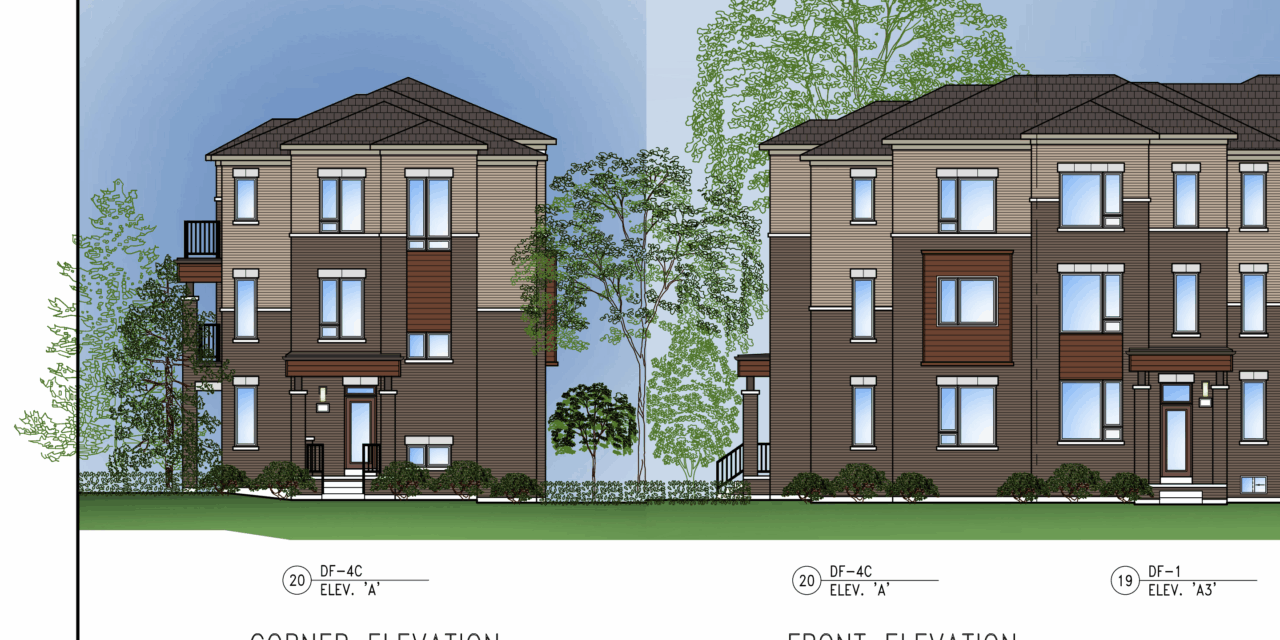
- Madori Limited is proposing 20 three-storey freehold townhouses at Ninth Line and Elm Road.
- The proposal was recently presented during an Oct. 1 Public Planning Meeting.
- Council debate centred on whether the proposed internal road should be publicly or privately owned and operated.
- The road’s ownership model directly affects whether the units can be sold as freehold homes, influencing their affordability.
- Town Staff say the road does not meet engineering standards to justify public ownership, and its minimal width could impact delivery of municipal services.
- While supporting the proposal generally, Council members also raised concerns over green space, traffic safety, and parking.
- Following further review, a Staff recommendation will come to Council for a final decision.
A townhouse proposal for 12410 Ninth Line was presented during Stouffville’s statutory Public Planning Meeting on Oct. 1, stirring debate over whether its road should be publicly or privately owned and operated.
Fieldgate subsidiary Madori Limited, through its planner The Biglieri Group, is hoping to build 20 three-storey freehold townhouses on the vacant northwest corner lot at Ninth Line and Elm Road. The 0.36-hectare property fronts mainly onto Elm and is surrounded by established residential and community uses, including Glad Park Public School to the north and the Elmwood Gardens seniors’ apartments to the west.
The proposed subdivision would divide the site into three blocks and introduce a new centralized east-west public road connecting Ninth Line and Elm. Desired Zoning By-law amendments would permit smaller yards and increased heights of nearly 11 metres to accommodate the development.
Mallory Nievas of The Biglieri Group said the design minimizes driveway visibility along Elm, with parking provided internally through driveways and garages, and balconies oriented inward toward the new street. “Matters of privacy and overlook onto adjacent properties is not a concern here,” she said.
Public ownership of the proposed street would allow Madori to offer freehold townhouses, which they prefer over having to establish a condominium corporation to manage a private road and any necessary communal services. However, Town Staff expressed concerns about whether the proposed laneway meets municipal standards for public assumption.
The road’s limited width could impact services Stouffville would need to provide should the street be public, including snow management and removal, waste collection, and utility and emergency vehicles’ need to turn around should the street be blocked. Engineering Staff have recommended the road, as currently proposed, should be private.
Other issues were flagged within the site design, including minimal landscaped area and limited opportunities for visitor parking and public realm. Staff have requested further justification on how the project aligns with the Town’s Official Plan, particularly in relation to the proposed density and matching of existing neighbourhood character.
Fieldgate Vice President Michael McLean said the company’s goal is to deliver a freehold townhouse product without the ongoing costs of condominium management. That goal depends on the Town’s acceptance of a “public laneway” model, which is a relatively new concept in Stouffville’s planning and engineering frameworks.
“As the Town is aware, public laneways have not been part of the Town’s repertoire of tools in the toolbox,” McLean told Council. “They’ve recently become part of that, and…we’ve been working with the Town to make technical submissions to support preliminary standards.”
Commissioner of Development Services Dwayne Tapp confirmed that regulatory standards for public laneways are still being formalized. Until then, such proposals will continue to be reviewed on a case-by-case basis.
Nievas acknowledged the road debate’s complexities, saying the proposed design is intended to function as an access route without pedestrian movements. Primarily meant for people to come into their driveway and leave, she said the roadway type, and public ownership of it, is common in other municipalities.
McLean also expressed frustration with the file’s long history. “Every time we come, ‘Thank you, but no thank you,’” he said, telling Council that discussions and revisions have spanned more than a decade. “We thought we’d spent a significant amount of consultative time with the Town in this recent go-around… We thought we’d landed on a good concept. Clearly, we have to go back and reconsider that.”
Ward 4 Councillor Rick Upton, who represents the area, voiced support for a public road model but said the proposal could benefit from some refinement.
“I think this project needs green space, and I believe two units could be removed from the plans to accommodate it,” Upton told Bullet Point News. “Kids need a swing set, residents need a place to take their dog, and we need to make sure public realm is added alongside any intensification of our neighbourhoods.”
Upton said he supports the gentle intensification presented by the proposal, but he also wants to see the units delivered as freehold towns. “That will require the internal road to be public, and I think that’s easier done if the unit count was reduced.”
Ward 6 Councillor Hugo Kroon raised concerns about traffic flow and safety, noting the laneway’s curved layout in consideration of how drivers might move through the development. “I see this little laneway with a couple of curves in it could potentially be quite dangerous,” he said.
In Kroon’s view, a private road design could mitigate those risks. “You could [control] the traffic and protect the people in that community,” he said.
Mayor Iain Lovatt expressed support for the project’s general form but questioned the proposed connection to Ninth Line. He suggested restricting that access to emergency vehicles only, requiring residents to enter and exit through Elm Road while preventing motorists from using the site as a shortcut.
Lovatt also floated the idea of reducing the unit count to 18, which he believes could facilitate additional visitor parking spaces. “I think it is a good product,” Lovatt said of the overall concept. “It’s appropriate for the location.”
In response to calls for added green space, Nievas said the team examined the feasibility of a parkette but found the lot size too constrained. Instead, the developer plans to take advantage of the option to contribute cash in lieu of mandated parkland.
Parkettes need to be designed and implemented in a way that allows for meaningful programming and use, Nievas said. “With that context, and with the context of the site and its characteristics, we just feel that providing parkland here is not feasible.”
Upton pushed back, pointing to the scarcity of available land within built-up parts of Stouffville. “There is a concern with [cash in lieu]: we have no land, we can’t go buy anything,” he said. “The developers have taken it all up. I’m not mad at that, but that’s a fact.”
Madori’s proposal would join another cluster of 12 townhouses still under review nearby on Elm Road. If approved, the project will replace three existing homes at 338 Elm Road, 124 Fairview Avenue, and 340 Glad Park Avenue.
For 12410 Ninth Line, Town Staff will continue working with Madori and its planners before bringing a future recommendation report to Council for a final decision.
Cover image shows a portion of drawings by VA3 Design, property of Madori Limited