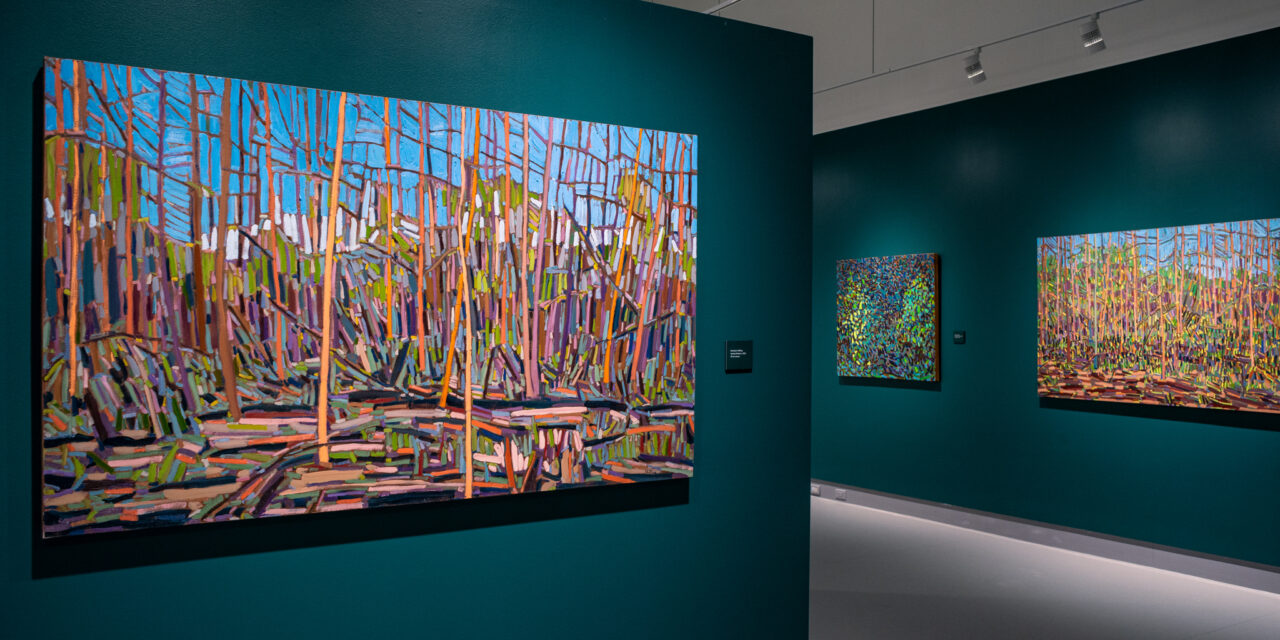
- Bewabon Shilling’s of light and air exhibition is currently on display at the Latcham Art Gallery.
- Included paintings feature landscapes of forests and fields near Shilling’s home studio in Rama First Nation, Ontario.
- Shilling often paints en plein air, a technique popularized by 19th-century Impressionists that embraces the shifting conditions of nature.
- His work is inspired by his late father, Ojibwe artist Arthur Shilling, continuing a legacy that bridges Western and Indigenous traditions.
- The exhibition runs until Oct. 25 at 2 Park Drive.
The Latcham Art Gallery is hosting of light and air, a solo exhibition by painter Bewabon Shilling, on view until Oct. 25 at 2 Park Drive. The show explores the forests and fields surrounding Shilling’s home in Rama First Nation, themes that have shaped his practice for more than two decades.
Shilling often paints en plein air, a method of working directly within the landscape being depicted. Popularized by 19th-century Impressionists, Latcham Curator Jeffrey Nye explains how the practice places the artist at the mercy of changing light, shifting atmosphere, and fleeting moments in nature.
“To watch Bewabon Shilling at work is to witness an artist challenging his eye to see clearly, his hand to be sure, and his mind to remain open,” writes Nye in the exhibition brochure. “Shilling sometimes describes his process as a battle, as he attempts to translate the ever-changing, living spaces before him into paintings that convey not only his visual and physical perceptions but also his intimate connection to the places he paints.”
The artist embraces these challenges, with each canvas reflecting not only what he observes but also what he feels. “We’re out of the studio, we’re right in here, right? We’re right with these trees… We’re part of the leaves,” he said in a recorded conversation with the gallery. “It’s just so alive.”
At the heart of his work is the influence of his late father, Ojibwe artist Arthur Shilling, who was celebrated for painting family and community members directly from life. That same sense of intimacy and immediacy can be found within Bewabon’s landscapes.
The exhibition presents two interwoven series. His field paintings began with a chance encounter with a solitary tree in an open field near Rama, compelling him to stop the car and capture the scene. Over time, he shifted from expansive skies to compositions dominated by abstract brushstrokes that immerse the viewer in colour and rhythm.
His forest paintings capture the shifting play of light filtering through the woods outside his studio windows. “The results are almost kaleidoscopic,” Nye notes. “The scenes fractured into distinct shards of colour as Bewabon’s eye follows the movement of light and colour across the landscape.”
Shilling lives and works in the home and studio his father built in the 1970s, carrying forward a legacy of artmaking that bridges Western and Indigenous traditions.
“Each of Shilling’s paintings offers a glimpse into a way of being that appreciates the remarkable beauty and ancestral connection to the places, and the artistry, that are integral to his history and identity,” Nye concludes.