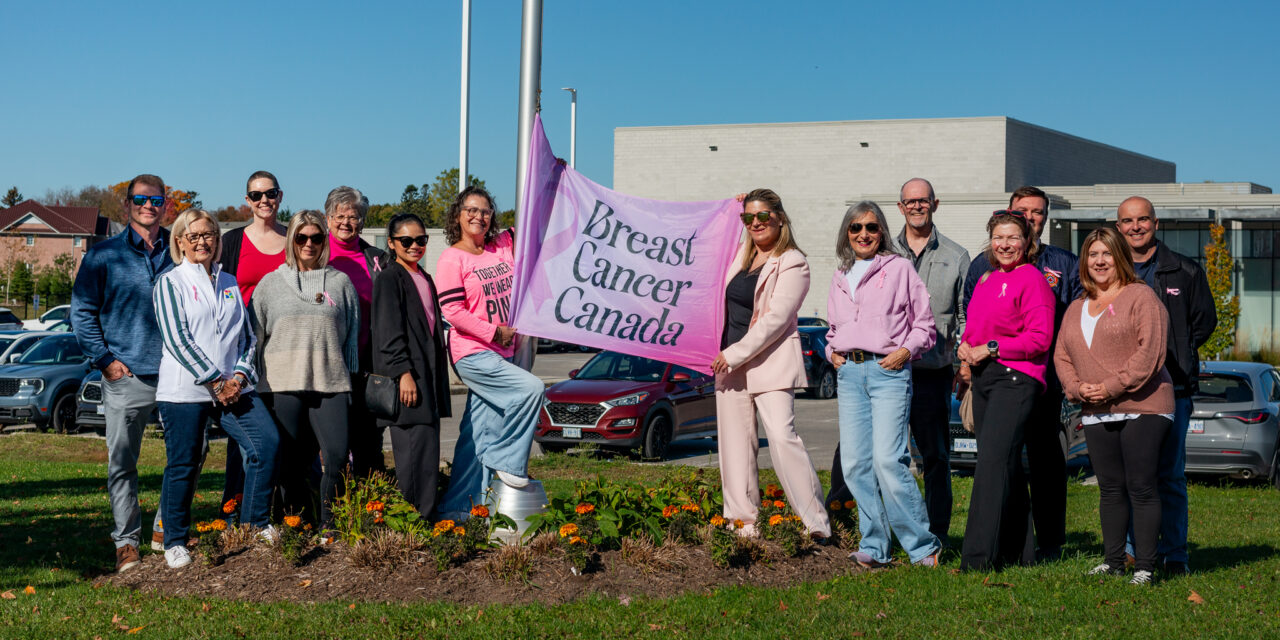
- The Breast Cancer Canada flag was raised at Stouffville’s community flag pole on Oct. 19 in recognition of Breast Cancer Awareness Month.
- Local survivors say many of the supports that carried them through diagnosis and treatment were found outside the healthcare system, and often by chance.
- Breast Cancer Canada’s Marie Grgic is piloting a patient ambassador program at Markham Stouffville Hospital to pair newly diagnosed patients with trained volunteers, many of them survivors.
- Michelle Enero and Luce Robert describe how trusting their instincts and keeping a routine mammogram led to their diagnoses.
- Paula Guerreiro founded the Stouffville-Markham Breast Cancer Support Group so no local woman has to face breast cancer alone, during treatment or survivorship.
- Vanessa Freeman, owner of the Pink Ribbon Boutique in Markham, works to restore a sense of choice and comfort for women after surgery, advocating for increased provincial funding for prosthetics.
- The women say residents can help by volunteering, raising awareness about the disease and its impacts on patients and their families, and offering practical support to those in treatment.
For more than four decades, October has been recognized as Breast Cancer Awareness Month. The stretch of the calendar is now synonymous with pink ribbons and pink lights, and on Monday, the Breast Cancer Canada flag was raised at Stouffville’s community flag pole.
The flag will fly for the rest of October, and the Civic Square Clock Tower will feature pink commemorative lighting throughout the week. For the local women behind the effort, the flag is meant to be more than a seasonal reminder.
“Raising this flag is a beacon of unity, really,” said Marie Grgic, a Stouffville resident and the Volunteer and Engagement Coordinator with Breast Cancer Canada (BCC). Ahead of the flag raising, Bullet Point News spoke with Grgic and several other local women whose lives have been shaped by breast cancer.
Both candid and unique, their stories shared a common thread: important pillars that supported and helped them persevere through treatment and survivorship were found outside the healthcare system, often by chance, and almost always through other women who had walked the same path.
They offered a window into the lived experience of patients and survivors and how they navigated and responded to their breast cancer journeys, pushing awareness of the disease well beyond pink ribbons.
Giving Back to the Community That Cared for Her
Grgic grew up in the area and raised her own children here. When she was diagnosed with breast cancer in November 2022, she was treated close to home at Markham Stouffville Hospital (MSH), where she says the care was excellent.
Volunteering with BCC and the Canadian Cancer Society soon followed, and in January she joined BCC to oversee its National Volunteer Program. “How do I give back to the community that treated me and served me?” she said of her motivation.
BCC “envision[s] a future where every Canadian has access to the best possible care, and ultimately, a world without breast cancer.” Funds raised by the organization support research through 34 labs aimed at developing less invasive and less toxic treatments, and at closing gaps so patients receive the same standard of care no matter where they live.
The charity is now growing its focus on life after treatment, because “care doesn’t end when treatment stops,” Grgic said.
Her first local initiative with BCC is a patient ambassador pilot program at Markham Stouffville Hospital. From the onset of diagnosis, patients will have the opportunity to be matched with a trained volunteer, often a survivor, who can help them understand their diagnosis, navigate resources inside and outside the hospital system, and advocate for themselves.
“Every Single Woman Is Unique”
Michelle Enero is among the volunteers helping bring the ambassador program to life.
In 2016, Enero was 31 and the mother of two young children when imaging found something in her breast. She was told she was likely too young for it to be cancer, that it was probably a cyst, and to return in six months.
“I had something in my gut that said, ‘You know what? We’re gonna go back earlier,’” she recalled. An ultrasound three months later showed the mass had grown significantly. A biopsy confirmed triple-negative breast cancer, a less common and more aggressive form of the disease.
“It’s like, ‘Here’s a bunch of papers, and we’re gonna see you next week for your first appointment,’” Enero said. “Wait, what?”
Within about a week and a half, she was in treatment and surgery at MSH. Enero had already lost her mother to another form of cancer after serving as her caregiver, and said being the patient was “a whole different ballgame.”
It was her oncologist’s referral to a local support group that she credits with getting her through. “If I didn’t have these amazing ladies, I do not know how I would’ve survived, because no one else knows what you’re going through physically, mentally, and emotionally than someone who has gone through it and is going through it,” she explained.
“Don’t Delay Your Mammograms”
For Luce Robert, the lesson is early detection.
Robert was 50, healthy, and training for a long-distance run when a routine mammogram came due during the COVID-19 pandemic. Feeling fine and uneasy about visiting a hospital in the middle of a lockdown, she planned to postpone it.
“I was convinced not to postpone it, and I’m so grateful I did not, because they did see something which I did not feel,” she said.
Pandemic restrictions meant she attended most of her follow-up appointments alone. When staff allowed her husband to join her for results, she knew the news would not be good. “I remember sitting in the waiting room there and just, like, bawling,” Robert said.
Initially diagnosed at stage zero, her cancer was reclassified as stage two following surgery about a month later. While she felt supported by family, friends, and neighbours, the community supports she might have turned to were closed. Today, Robert is a patient advocate with BCC, offering those supports to others while encouraging others to keep their screening appointments.
She also has advice for those who want to help but aren’t sure how.
People going through treatment rarely act on an open-ended “whatever you need, let me know,” Robert told us. Being proactive and offering something specific instead, like picking up groceries, helping with laundry, or driving them to the hospital, is a great way to help.
Robert asked people to remember partners, too, whom she called the “unsung heroes” of a diagnosis. “When you meet family and friends, you’ll have your smile,” she said. “They see behind the scenes.”
Filling a Void Close to Home
Paula Guerreiro spent more than 20 years as a provincial prosecutor before a breast cancer diagnosis in 2014 abruptly changed her life.
Her cancer, an aggressive, hormone receptor-positive form of the disease, was diagnosed at stage three and had already spread. Six years of treatment included 10 surgeries, eight rounds of chemotherapy, and 25 rounds of radiation. She was also diagnosed with stage two thyroid cancer.
Early in her treatment, she joined a Markham support group: “Knowing that there are other people that had walked the path that you are walking helped immensely,” Guerreiro said.
That group was dismantled during the pandemic, leaving nothing in the Markham-Stouffville area. The closest alternatives Guerreiro could find were Hearth Place in Oshawa or programs in downtown Toronto.
So she started her own.
Drawing on her experience as both a patient and a family member who lost a loved one to cancer, Guerreiro launched the Stouffville-Markham Breast Cancer Support Group. Corner Spa and Wellness donates space for its meetings.
The group is now outgrowing it, which Guerreiro called “kind of sad, but kind of incredible at the same time.”
A Sisterhood Beyond Treatment
Guerreiro said she built the Stouffville-Markham Breast Cancer Support Group around a simple goal: that no woman in the community should ever feel she is facing breast cancer alone, as she once did.
For someone newly diagnosed, the world suddenly fills with fear, uncertainty, and an overwhelming amount of information. Guerreiro wants the group to be a place where that woman “can walk through the door, take a deep breath, and know that she is surrounded by women who genuinely understand what she’s going through.”
But the group isn’t only for the newly diagnosed. “Breast cancer doesn’t end when the treatment ends,” she explained. Fear and other emotional and psychological effects can linger for years, alongside body changes and “the constant process of learning to trust life again.”
Women who keep attending years after their diagnosis bring wisdom, hope, and “living proof that there is a life beyond cancer,” Guerreiro said. Meetings aren’t always about cancer, either. Members laugh, share stories, celebrate milestones, and build friendships.
“Cancer may be what brought us together, but it doesn’t have to be what keeps us together,” she told us.
Her work has since expanded into Radiantly Rooted, a separate three-month program in Stouffville for women before, during, or after treatment, built on the idea that “your cancer is not you.”
Restoring a Sense of Choice
Vanessa Freeman comes to breast cancer from a different angle. She describes herself as a “previvor,” someone who has not had cancer but carries a high risk of developing it. After her mother was diagnosed with breast cancer twice, genetic testing showed Freeman carried the BRCA2 gene mutation, and she chose to have a preventative double mastectomy.
That experience led her to leave a 20-year career in graphic design and purchase the Pink Ribbon Boutique, which supports women “from diagnosis through to living.” The boutique offers breast forms and post-surgical products, and helps clients navigate insurance and government funding.
At the heart of that work, Freeman said, is giving women back a sense of control. “Once you’re in the cancer journey, you don’t have a lot of choice,” she said. “You’re kind of along for the ride.”
That includes making sure women know reconstruction is an option, not a requirement. Grgic, who chose not to have reconstruction, called the boutique her “anchor” through treatment.
Freeman also donates soft post-surgical forms, which she calls “puffs,” to MSH, so patients have the option of wearing something in their bra right after surgery.
Cost remains a barrier, however. Ontario’s Assistive Devices Program has been frozen at its 2006 rate, providing just $195 toward a breast prosthesis. Freeman estimates the average form now costs about $450, and she is part of an advocacy group pushing the Province to increase that funding.
Beyond the Pink
October will end, and the pink will come down with it. The women Bullet Point News spoke with are looking ahead to what increased awareness can bring to others facing the same diagnosis.
That’s where residents come in, and the ask has little to do with money. Grgic is looking for volunteers to serve as patient ambassadors, and for advocates willing to share their stories, particularly those who speak languages other than English. Residents can reach her through the BCC website.
In Guerreiro’s view, it starts with spreading the word, so free programs like her support group can reach the people who need them. Sometimes, that awareness gives back in ways no one expects. After learning about the group’s work, the Stouffville Market made a donation to help it keep going. No one had asked.
“I saw the impact and meaning that sharing stories and supporting each other gave to members of the group,” Stouffville Market organizer Susan Tucker told us, referencing interviews she conducted with them for a recent article in On the Road magazine. “The group removes the feeling of ‘I thought it was just me,’ and it shows each member that they are not alone in their battle.”
As Guerreiro noted, the woman who needs encouragement today may be the one offering it to someone else tomorrow.
For Grgic, that is what the Breast Cancer Canada flag represents: “I think it’s just women supporting women.”