- Musselman’s Lake residents reviewed final recommendations for Ninth Line during a June 18 public meeting.
- Speed limits around the lake are expected to drop from 40 km/h to 30 km/h, with three new all-way stops added.
- York Region and Stouffville are also pursuing a road transfer agreement that would place the Musselman’s Lake segment of Ninth Line under Town ownership.
- Rehabilitation work, slope stabilization, and new guide rails are planned as part of the Regional project currently estimated at $6 million.
- Public opposition to one-way traffic operations and use of easement lands helped to eliminate options for separated pedestrian infrastructure.
- Officials say the project will create a safer, slower neighbourhood street while maintaining two-way traffic access.
- Engineering and design work could begin in 2027, with construction targeted for 2028.
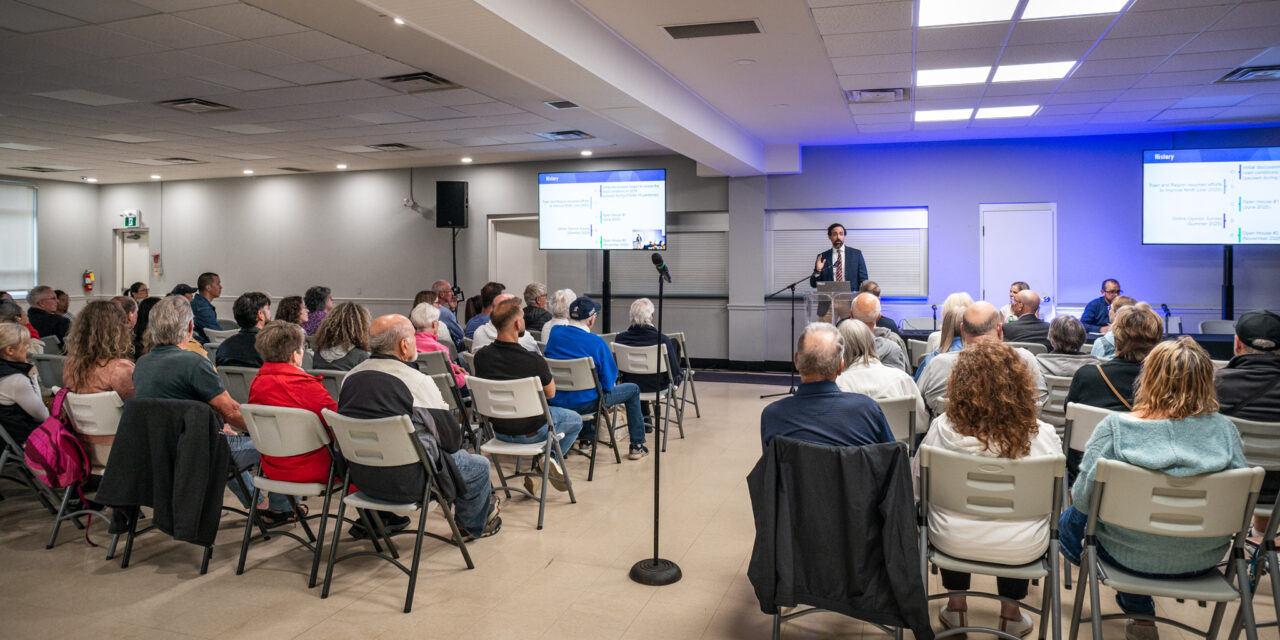
Musselman’s Lake residents rejoined a Stouffville and York Region project team at the Ballantrae Community Centre on Thursday evening for a third public meeting focused on the future of Ninth Line.
Both governments are working toward a compromise that aims to create a slower, safer neighbourhood street while balancing vehicle access, pedestrian safety, infrastructure needs, and local interests.
At the centre of the proposal is a pending road transfer agreement that would see Stouffville assume ownership of Ninth Line between Hillsdale Drive and Aurora Road. To offset the operating and financial implications for both municipalities, the Town would transfer an equivalent section of McCowan Road between Bloomington Road and Aurora Road to York Region.
Anticipation surrounding the meeting had been building for weeks after overhead warning lights were installed in the area of Lakeshore Road and Ninth Line. Some residents wondered whether the improvements were connected to the visioning study, which has been underway since 2018.
Attendees reiterated decades-old concerns surrounding threats to pedestrians and motorists, roadway deterioration, and a perceived lack of speeding enforcement. While the new lighting warning of approaching intersections was installed through a separate York Region road safety initiative, the change has been welcomed in a community eager for solutions.
Final recommendations stemming from the visioning study include a 10 km/h speed limit reduction, three new all-way stops along Ninth Line, slope stabilization, and resurfacing. Although the study explored several options to accommodate separated pedestrian infrastructure, physical constraints and community opposition ultimately narrowed the scope of the project.
Staff and Mayor Iain Lovatt assured residents that both safety improvements and traffic enforcement efforts are advancing, drawing repeated expressions of appreciation from attendees. Traffic-control changes are expected to be implemented in the near term, while rehabilitation work is targeted for 2028 at no cost to the Town.
Slowing Down Ninth Line
Thomas Macpherson, York Region Transportation Manager of Long-Term Planning, said their review concluded the corridor functions less like a typical Regional roadway and more like a neighbourhood street. As a result, the speed limit will be reduced from 40 km/h to 30 km/h along the Musselman’s Lake segment.
While Regional roads are generally designed to support higher traffic volumes and faster travel, Macpherson suggested Ninth Line serves a distinctly local role that supports a lower operating speed.
Three all-way stops have also been proposed at Lakeshore Road, Coultice Park, and Cedarvale Boulevard. Staff described the intersections as strategic locations for the traffic calming measures, as they will interrupt longer stretches where drivers are able to reach excessive speeds.
While the proposed stop at Coultice Park drew little criticism, the Lakeshore and Cedarvale locations revived longstanding concerns about visibility, elevation changes, and winter driving conditions.
Residents pointed to blind corners, limited sightlines, and steeper grades impacting both intersections. Others worried vehicles could slide downhill during icy conditions as traffic queues at the new stops.
The discussion prompted requests for enhanced winter maintenance once the Town assumes responsibility for the roadway. Several residents suggested the Lake area’s unique microclimate produces heavier snowfall and ice accumulation than elsewhere in the municipality.
Stouffville Commissioner of Engineering and Public Works Jack Graziosi said the Town strives to meet provincial maintenance standards, and the project team committed to reviewing the concerns. Mayor Lovatt added that while increased salting could improve winter driving conditions in the area, excessive road salt remains a significant contributor to lake pollution—an issue the Town and local community are eager to address.
A Long-Needed Infrastructure Project
Although much of the public discussion has centred on traffic calming and pedestrian safety, the initiative also addresses significant infrastructure deficiencies along Ninth Line.
Council levied criticism against York Region during its consideration of the study in May 2025, when members emphasized that Stouffville was interested in assuming the road but not the liability associated with its current condition. Lovatt previously suggested the project could cost approximately $2 million, but more recent estimates place the preliminary budget closer to $6 million.
The rehabilitation plan includes resurfacing and recrowning the roadway to restore its proper drainage profile. New guide rails are also proposed, which could be redesigned and made more aesthetically appropriate after Ninth Line is handed to the Town.
Equally important is the stabilization of sloping adjacent to Musselman’s Lake. Both residents and officials noted that portions of the road edge are gradually eroding and “falling into the lake,” creating constriction points by reducing available street width.
According to Graziosi, the work should extend the service life of the Ninth Line segment by at least 25 years, barring any force majeure events, which would protect the Town from unplanned capital expenditures after the transfer.
Balancing Pedestrian Safety & Property Rights
Since last June, the project team has examined a variety of concepts aimed at creating space for pedestrian infrastructure within the constrained right-of-way.
Ideas considered included alternating one-way traffic operations around the lake and utilizing portions of public easement lands currently in use by abutting properties. Both approaches could have created room for a dedicated sidewalk or multi-use trail, but neither gained sufficient community support.
Referencing preventable injuries involving children and safety concerns when walking to popular locations like Coultice Park and Lolli & Pops, a resident working in the healthcare sector argued that the project represents a rare opportunity to make meaningful improvements.
“We see serious injuries, and if we have the capacity now to make a difference, to prevent even one person from getting hurt, I think now is the time,” they said. “Especially if somebody else is going to foot the bill.”
Supporters of one-way traffic argued the change could discourage non-local motorists from using the neighbourhood as a throughway. Opponents countered that it would negatively affect local travel patterns and create inconvenience for residents, depending on their location.
“We heard a mix of thoughtful ideas, as well as some significant concerns including impacts to property access, emergency services, and potential for traffic patterns to shift into other areas of the community,” Stouffville Capital Project Manager Mandy Paglia explained.
“We’re proceeding with a design that maintains two way traffic,” she confirmed to applause.
Debate also emerged over the potential use of easement lands, a consideration presented during the second public meeting last November. While some residents encouraged additional investigation into the idea, others appeared strongly opposed to any proposal that would encroach on lands they currently use.
At one point, a resident asking Staff to continue pursuing the option was interrupted by another, who told him to move. The exchange prompted Graziosi to interject and reiterate that neither Stouffville nor York Region is interested in pursuing a solution that would create conflict with property owners.
“This is about trying to be respectful of the community and meeting the broader community’s needs,” he said, adding that if it was feasible to extend the lake side to accommodate a sidewalk, they would. “This project is all about compromises.”
While separated pedestrian infrastructure proved impractical, Graziosi confirmed the combination of slope stabilization and roadway rehabilitation is expected to create enough room for a continuous shoulder along Ninth Line. Although engineering and design work has yet to begin, he suggested a width of approximately one metre may be achievable.
Increased Police Attention
Beyond the planned roadway changes, Mayor Lovatt said persistent requests for enforcement have generated results from York Regional Police.
Following targeted enforcement efforts along the southern portion of Ninth Line earlier this year, officers identified speeding as a recurring issue and designated the corridor as an enforcement priority.
Residents noted that police activity appears concentrated near the Regional water tower, south of the community. While many said they would welcome additional enforcement within the Musselman’s Lake neighbourhood, they also expressed appreciation for the increased police presence.
Next Steps
Council approved formal correspondence supporting the road transfer and project framework on May 20. The package has been forwarded to York Region, where Regional Council is expected to receive and refer the matter to Staff on June 25.
York Region’s Transportation team would then prepare a recommendation report. If approved, engineering and design work would begin in 2027, with additional public consultation expected during that phase. Construction is scheduled for 2028.
Macpherson said Regional Staff support both the project and its preliminary budget request, which will be considered through York Region’s 2027 budget process.
The bullet points at the top of this article were updated to clarify that the Town will assume just the Musselman’s Lake segment of Ninth Line, not the entire roadway.