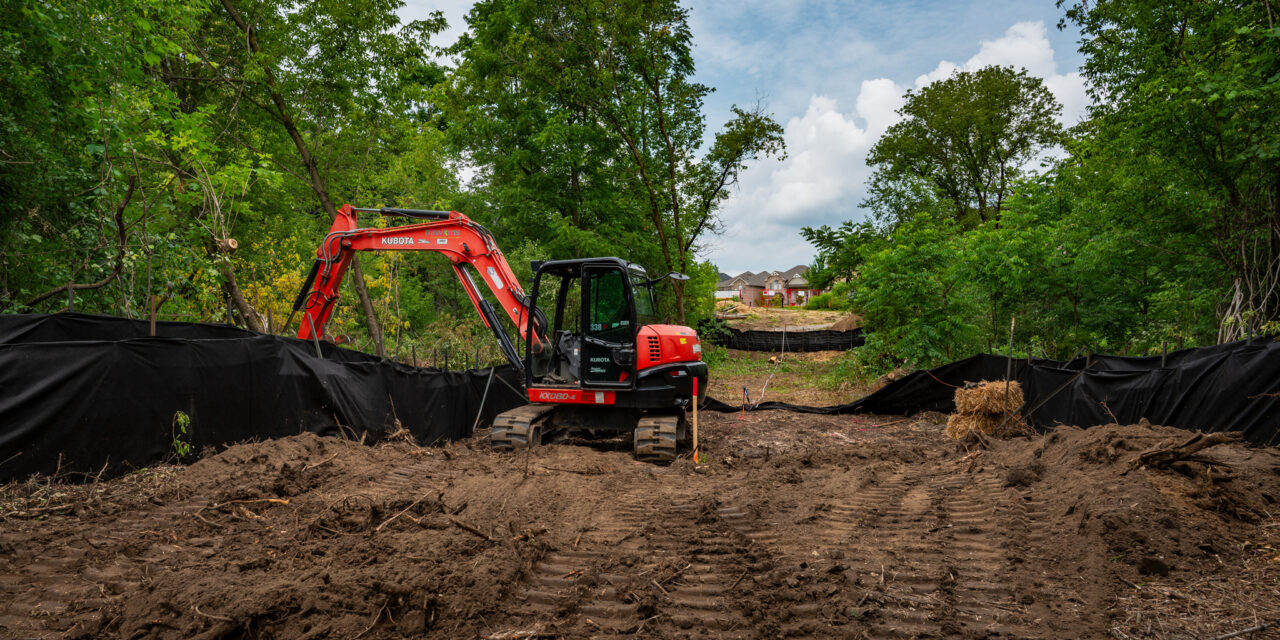
- A new pedestrian and cycling trail is under construction to connect Ken Betz Court with Madori Park.
- The pathway includes a 32-metre prefabricated bridge spanning the Little Rouge Creek West tributary.
- The project is expected to be completed by the end of October 2025, and Madori Park will remain open throughout the process.
- Archaeological and environmental safeguards have been implemented, including protections for endangered Redside Dace.
- Five trees will be removed and replaced with 94 native tree and shrub plantings as part of site restoration.
- The new connection will replace an informal footpath and creek crossing worn in by residents.
Construction has begun on a new multi-use trail and bridge linking Ken Betz Court to Madori Park. Once complete, the pedestrian and cycling route will provide direct access to both the park and the Millard Street West Trail system for those living within the growing Baker Hill development area.
The three-metre-wide pathway will extend from Madori Park’s existing paved trail network, heading northwest toward a new 32-metre steel truss bridge spanning the Little Rouge Creek West tributary. On the opposite bank, a granular trail will continue to Ken Betz Court.
An informal crossing has already been carved out by locals over the creek, which will now be replaced with a permanent, safer, and more accessible route. While Madori Park will remain open throughout construction, visitors are advised to exercise caution along trails due to the presence of construction vehicles and crews.
Execution is in the hands of Hawkins Contracting Services and comes with an approved 2025 capital budget of $725,000 for final design and construction. While 90 percent of those costs are funded through development charges, that amount is not inclusive of previous studies conducted to support the project.
The project was initiated in 2022 under the Municipal Class Environmental Assessment (EA) process. In 2023, it was reclassified as exempt from the EA under new Provincial rules. Despite that exemption, the Town says it continued to consult public and Indigenous stakeholders.
Early site preparation included mitigation measures to protect a nearby archaeologically sensitive area. A Town presentation explained that 19th-century European settler artifacts, primarily consisting of “domestic refuse,” were found during initial investigations. This triggered additional archaeological assessments which did not uncover further artifacts and cleared the way for construction.
Redside Dace, a listed endangered fish species, have been found in the surrounding watershed. Construction timing and methods have been adapted to protect the fish and maintain habitat integrity. While levels are currently very low, the project does not involve any in-water work. The bridge will be prefabricated off-site and assembled on location atop concrete footings.
Stouffville has also secured approvals from relevant government ministries and agencies, such as Ontario’s Ministry of Environment, Conservation, and Parks, the Department of Fisheries and Oceans Canada, and Toronto and Region Conservation Authority.
Five trees will be removed during construction, with some additional pruning as needed. All impacted trees are considered common species and not part of sensitive habitat, and tree removal is conditional on ensuring no active bird nests are present. As part of the site’s restoration, 94 native trees and shrubs will be planted.
Work is expected to be completed by the end of October 2025.