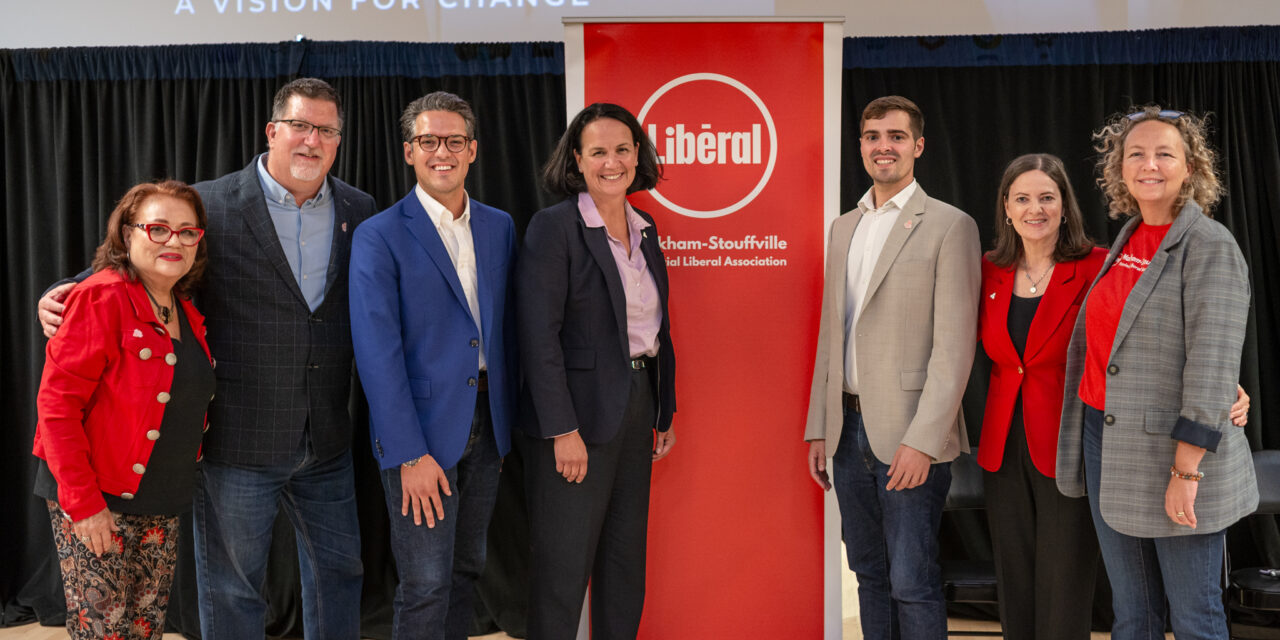
- Four candidates for Ontario Liberal Party leader joined a Sept. 29 town hall at Stouffville’s 19 on the Park.
- Participants included MPP Stephanie Bowman, MPP Lee Fairclough, housing advocate Eric Lombardi, and former PMO policy director Dylan Marando.
- The evening focused largely on policy, touching on trade, artificial intelligence, healthcare, education, and economic growth.
- Candidates were also asked how they would stabilize municipal finances amid increasing fiscal and growth pressures.
- The panel pledged to end strong mayor powers and the appointment of regional chairs.
- As the party works to rebuild, members will still play a key role in formalizing the Ontario Liberal’s future policy base.
- Navdeep Bains did not participate, and Lombardi has since ended his campaign and endorsed Fairclough.
- Kelly Dunn, the OLP Candidate of Record for Markham–Stouffville, has endorsed Bowman.
Four candidates vying to lead the Ontario Liberal Party (OLP) brought their pitches to Stouffville on Tuesday night, joining a town hall organized by the Markham–Stouffville Provincial Liberal Association.
Area party members and campaign teams filled the audience at 19 on the Park, where candidates fielded questions ranging from artificial intelligence and trade to healthcare, education, and municipal finances.
Those in attendance included Stephanie Bowman, MPP for Don Valley West; Lee Fairclough, MPP for Etobicoke–Lakeshore; housing policy advocate Eric Lombardi; and Dylan Marando, former Director of Policy to the Prime Minister. Navdeep Bains did not participate.
The field has since narrowed. Lombardi ended his campaign Wednesday evening, citing polling concerns and fundraising challenges, and endorsed Fairclough. Four candidates now remain.
Opening statements touched on affordability, economic stagnation, and the need for political renewal. While the evening included its share of criticism directed at Premier Doug Ford’s government, discussion centred largely on policy, with considerable overlap in the candidates’ positions.
Although each leadership hopeful brought forward their own platform ideas, the party and its members will still play a significant role in shaping the Ontario Liberals’ future policy base. That process could join internal reforms, a topic candidates discussed candidly while pointing to the need for greater involvement and stronger outreach to local communities.
Trade, AI & Public Services
Economic uncertainty, and its potential consequences for workers, local communities, and small businesses, provided an underlying theme as the panel turned to trade and artificial intelligence.
Bowman, the OLP’s critic for finance and trade, said Ontario has lost years of potential growth. She highlighted the need to improve economic productivity across the province and argued Ontario should take a stronger lead in dismantling interprovincial trade barriers to help weather the ongoing trade war between Canada and the United States.
Fairclough focused on economic development in northern Ontario as a means of driving gross domestic product. New opportunities in the north, including those related to energy and natural resources, would require the migration of domestic and international newcomers to the region. With renewed momentum and the right incentives, she said Ontario could become a top-three destination for new business in North America.
Data sovereignty emerged as a leading concern during the discussion on artificial intelligence, with candidates acknowledging both the opportunities and threats presented by the rapidly growing technology. The panel also highlighted the need for Ontario to adapt quickly and responsibly to the changing AI landscape.
Lombardi said addressing concerns about job losses would require identifying new career paths and establishing support programs for affected workers. He also suggested the energy demands of data centres could provide an opportunity to develop a new clean energy program in Ontario, helping avoid some of the environmental and ratepayer consequences associated with their proliferation.
Marando presented healthcare and education as not just priority responsibilities of the Ontario government, but as high-yielding investments in the province’s people and economy. Referring to publicly funded education as the great equalizer and foundation of a skilled workforce, he suggested public education is an area where Ontario Liberals have the greatest credibility.
The other candidates echoed those sentiments, with the panel focusing on post-secondary education as an innovation hub that needs to be fostered. Doing so, they suggested, could help Ontario develop and scale more new ideas at home rather than seeing them leveraged elsewhere.
Municipal Finances & Local Democracy
Bullet Point News asked how each candidate would help stabilize municipal finances amid an increasing number of downloaded responsibilities, capital revenue challenges, and competition for difficult-to-access provincial and federal funding programs.
Candidates were also asked whether they would end strong mayor powers and appointed regional chairs. All four expressed support for doing so.
While noting that most mayors are not interested in exercising the strong mayor powers currently available to them, Fairclough said her platform would eliminate the executive authority and end the appointment of regional chairs.
“Municipalities just need a partner in government again,” she said, noting that downloads related to healthcare and homelessness amount to approximately $4 billion province-wide. “We need a new deal. We need a new way to fund municipalities.”
Fairclough also expressed interest in gauging public appetite for electoral and campaign finance reforms, promising that a member of her caucus would be tasked with examining both issues.
Bowman described reversing strong mayor powers and ending appointed regional chairs as steps toward restoring trust in democracy. She recalled delegates at the recent Association of Municipalities of Ontario conference nearly booing when Ford said his government had never raised a tax, arguing that municipalities were instead increasing property taxes to cover downloaded responsibilities.
Infrastructure dollars belong in cities, Bowman added, while criticizing some of the Province’s recent capital spending priorities.
“ We know that we have significant infrastructure gaps, and that is one of the reasons that I do not believe we should have built a spa in Ontario Place or closed down the Science Center,” she explained.
Marando also committed to ending strong mayor powers and appointed regional chairs. He further advocated for more stringent requirements justifying provincial supervision of school boards, saying voters need to be trusted to address concerns involving their elected trustees.
Beyond considering possible uploads of responsibilities, Marando proposed providing municipalities with permanent annual funding equivalent to one percentage point of HST revenues. Distributed through a formula rather than an application process, he argued the funding would address a system in which application-based programs disadvantage smaller municipalities. He said local leaders and service providers should be consulted to develop the program.
Lombardi said Ontario could consider uploading billions in municipal health and housing costs downloaded in the 1990s. He also supported a funding program drawing on one percent of HST revenues, suggesting the measures could help close billions of dollars in municipal infrastructure gaps while still allowing for reduced taxes on housing.
Rebuilding the Party
The event was not blind to the Ontario Liberals’ position at Queen’s Park. Party status was narrowly secured in last year’s snap election, with the caucus growing from nine to 14 seats. Leadership candidates and local Provincial Liberal Associations (PLA) are now looking to make further gains.
That effort is familiar to Kelly Dunn, a sitting director and past president of the Markham–Stouffville PLA. Also the riding’s OLP Candidate of Record, she helped guide the evening’s discussion and spoke with Bullet Point News about the leadership race and the party’s ongoing efforts to rebuild.
“We recognize that this is a leadership contest of the third-place party, but I am reassured by the turnout on Tuesday night,” she said. “People in our riding still understand the value and importance of this race and the town hall.”
While many continue to associate the party with establishment politics, Dunn suggested the local association and the OLP more broadly are currently operating from a grassroots position—one that elevates the voices of individual members.
The approach is particularly evident at events like Tuesday night’s forum, where members had an opportunity to speak directly with leadership hopefuls and share their perspectives.
“If you can have influence over who the leader is, you can have influence over the vision of the party. Then, if things go well, you will influence the province,” Dunn explained. “I have found all of these candidates are open to listening, taking feedback, and even changing.”
She also returned to a message delivered by former U.S. President Franklin D. Roosevelt during American Education Week in 1938, which she read during the town hall.
“Democracy cannot succeed unless those who express their choice are prepared to choose wisely. The real safeguard of democracy, therefore, is education,” she said, quoting Roosevelt. “That might reflect some of the policy responses we heard, but it’s also why we are bringing events like these forward for our members.”
Dunn Endorses Bowman
With Lombardi’s departure narrowing the field, Dunn said her fellow Liberals are looking for a leader able to put forward a vision that works for all Ontarians.
She has thrown her support behind Stephanie Bowman, and with just over a month until ballots open Nov. 9, Dunn knows the stakes are rising for the Don Valley West MPP.
“I’m supporting Stephanie Bowman because Ontario is facing an uncertain economic future,” she told us. “We need a leader who will prioritize building a strong economic foundation, so we can be prepared for what’s next.”
Reflecting leading topics from Tuesday night’s town hall, she underscored tariffs, AI, and affordability as pressures on residents and economic opportunity. Adding climate change to the list, Dunn said those challenges are making life in Ontario harder, more expensive, and more precarious.
“A leader with economic experience and credentials will help guide Ontario through these uncharted waters,” Dunn said, referring to Bowman’s accounting and consulting experience. Before she was elected as a Member of Provincial Parliament in 2022, Bowman was a senior Scotiabank executive and a partner at Ernst & Young.
“We need people to know they have a voice, and we need them to believe in the party and where it’s going,” Dunn concluded. “We have a great slate of leadership candidates, but I know Stephanie is the right person for the job. She is ready to tackle the challenges Ontarians face today, and will continue to face in the future.”
Cover image shows (left to right): Leea Nutson, Markham–Stouffville PLA President; Chris Dudley, Markham–Stouffville PLA Director and event moderator; Dylan Marando, former PMO policy director; MPP Lee Fairclough, Etobicoke–Lakeshore; Eric Lombardi, housing advocate; MPP Stephanie Bowman, Don Valley West; Kelly Dunn, Markham–Stouffville PLA Director and Candidate of Record (Randy Barba | Sept. 29, 2026)