- Municipal investigations are underway following illegal dumping of asphalt grindings at sites in Stouffville and Uxbridge.
- The Town is investigating milled pavement from Stouffville Road as a possible source of material dumped at three locations identified by Bullet Point News.
- Forest Contractors Ltd., the proponent selected by York Region for the resurfacing project, is facing multiple charges.
- York Region has not disclosed contract terms, case information, declared destinations for the asphalt, or how regulatory compliance was overseen.
- While asphalt grindings can contain pollutants, preliminary testing of Stouffville Road found no hazardous contaminants.
- Grindings were dumped at a Bethesda Side Road property that appears to be physically connected to the Sleepy Hollow Golf and Country Club.
- A representative from Sleepy Hollow has denied any association between the Bethesda site and the club.
Across multiple nights in June, hundreds of trucks turned into a rural Stouffville property to dump asphalt grindings without permits or approvals. Milled pavement from York Region’s Stouffville Road resurfacing project is emerging as the suspected source, and multi-jurisdictional investigations are now examining several local dumping sites.
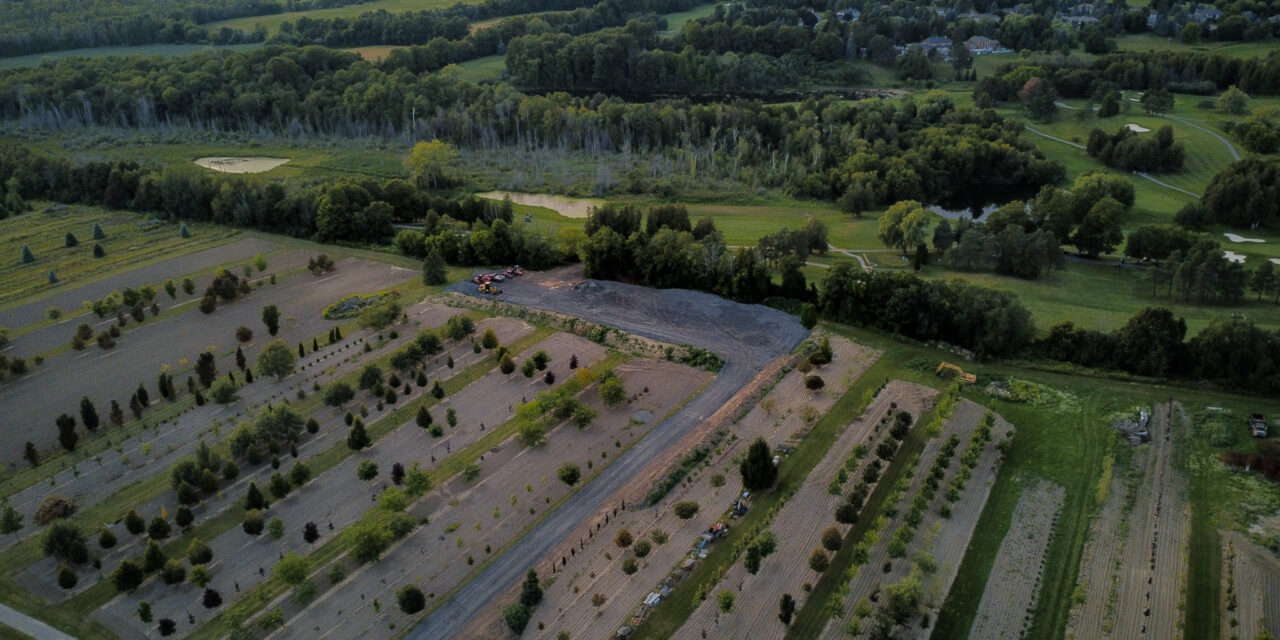
Alterations to the Oak Ridges Moraine Countryside lands at 6512 Bethesda Side Road have been significant. The site likely falls within one of the Moraine’s landform conservation areas, and it is just outside a wetland and watercourse area regulated by Toronto and Region Conservation Authority (TRCA).
The property was the first of four locations identified by Bullet Point News in connection with recent unpermitted dumping and site alteration activity, all of them within the Oak Ridges Moraine. Large stockpiles have since been identified in nearby Uxbridge and Stouffville’s west end, with the Town confirming that Stouffville Road millings are being investigated in connection with the material.
Charges have already been laid against Forest Contractors Ltd., the proponent selected by York Region for the Stouffville Road contract. Declining to specify the offences or confirm how many additional dump sites are under investigation, Town spokesperson Cassandra Papas said “the matter is before the courts.”
York Region has not directly responded to inquiries regarding Forest’s contract terms or declarations of third-party destinations for the asphalt. The Region has also not detailed where obligations lie in ensuring excess materials are managed in accordance with applicable regulations.
Bullet Point News made multiple attempts at speaking with Forest Contractors, but the company declined to comment for this story.
Following the Asphalt
The grindings dumped at 6512 Bethesda, which is currently leased for agricultural purposes, were graded into a rear paved lot and laneway stretching the 10-acre property. The total paved area covers thousands of square metres.
Asphalt appears several feet deep in some areas of the lot, and large chunks of relocated roadway have been seen scattered throughout. A recently constructed berm hides the worksite from the road.
According to Papas, “no approvals, permits, or agreements had been completed” prior to the delivery of grindings. Subsequent work removed trees along the northern property line, opening a gap and creating a physical link to the adjacent Sleepy Hollow Golf and Country Club lands.
Corporate records show the golf course and Bethesda property are owned through similarly named companies sharing the same sole director. However, Sleepy Hollow General Manager Kurtis Paisley said the Bethesda project is independent of the golf course.
A cease-and-desist order was issued after the dumping of asphalt began, and additional attempts by haulers to drop off grindings were unsuccessful. Trucks were seen stalled while attempting to reach the site, backing traffic onto Bethesda Side Road.
Paisley said those attempts came after the project team made “numerous requests” for deliveries to cease. He did not comment on where the material came from, but noted that he is working with all involved authorities.
A Mountain in Plain Sight
Asphalt grindings intended for immediate reuse are generally not considered waste under Ontario regulations, even when dumped in violation of municipal by-laws. If handled contrary to provincial requirements, however, they can lose that exemption and become subject to more serious industrial waste penalties.
Less than two kilometres from the Bethesda property, another Oak Ridges Moraine parcel has been tied to an illegal dumping investigation.
At 2499 York-Durham Line, an almost towering stockpile of what appears to be ground asphalt looms over the nearby barns. While visible from the road, aerial images reveal a massive accumulation of material on the rural-zoned lands.
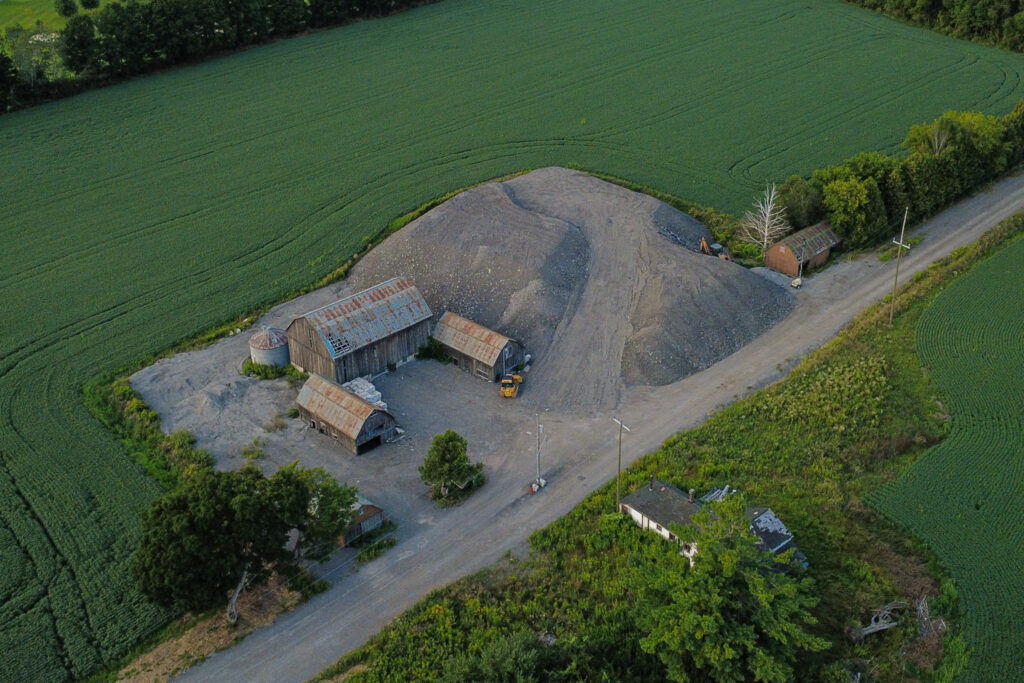
A large stockpile of material believed to be asphalt grindings has amassed at 2499 York-Durham Line in Uxbridge. (Aug. 18, 2026 | Bullet Point News)
The site was identified after a Bethesda resident reported regular evening truck movements toward York-Durham Line beginning in mid-July. They described tri-axle dump trucks with large boxes, similar to those seen entering 6512 Bethesda, travelling eastbound before returning roughly 20 minutes later with empty beds.
In response to inquiries, the Township of Uxbridge confirmed its by-law department is aware.
“The illegal dumping matter on York-Durham Line is currently an active investigation involving both the Township and the TRCA,” an Uxbridge communications officer told us. “As such, we are unable to discuss the details of the case at this time.”
The York-Durham Line stockpile is surrounded by active agricultural land uses. The property primarily consists of Oak Ridges Moraine Countryside area, but also contains a strip of more restrictive Natural Linkages lands.
“A portion of the property… is within an area regulated by TRCA,” a conservation authority spokesperson confirmed. “A TRCA permit may be required before development or other regulated activities are undertaken within the regulated portion of the property.”
That regulated area includes a watercourse, flood hazard area, and unevaluated wetland, all part of the Duffins Creek watershed.
Bullet Point News was told truck movements along Bethesda have recently stopped. While TRCA did not confirm whether it is investigating the material’s origin, Stouffville’s investigation has included the site as a possible destination for Stouffville Road grindings.
“The Town and the Region continue to work collaboratively to investigate,” Town spokesperson Glenn Jackson told us.
The Accountability Gap
With relatively few provincial regulations governing reclaimed asphalt, project and materials oversight depends heavily on municipal contract terms, provincial standards, and local by-law enforcement.
Project owners such as York Region establish and oversee contract requirements and execution. While provincial standards and regulations must be followed, it remains unclear whether any contract terms required Forest to operate in accordance with Stouffville by-laws.
Ontario Provincial Standard Specification 180 forms document agreements between contractors and third-party receiving sites for excess project materials. They give project owners an opportunity to assess and understand where those materials are expected to go.
Whether Forest identified and disclosed all of the sites now under investigation, and whether stated locations were reviewed by York Region before hauling began, is unknown.
Illegal dumping can reduce transporting and disposal costs for a contractor. Those savings might influence competitive bidding on public contracts, which benefits the project owner tendering the project.
Seven submissions are listed on York Region’s Bids and Tenders website for the Stouffville Road project, with an average bid of just under $17 million. Forest’s winning bid was $13,447,370, nearly $600,000 less than the second-lowest proposal.
Our investigation has been unable to identify a provincial standard or regulation that mandates adherence to local by-laws in this context, meaning the onus to be in compliance may fall entirely to the third-party property owners accepting material.
Enforcement and management burdens fall on the lower-tier municipalities where problems arise, however, not necessarily the project owner that awarded and oversaw the contract.
This leaves a broader question about whether procurement and contract standards, regulatory frameworks, and lacking oversight could be incentivizing or facilitating illegal dumping activities.
“York Region remains committed to ensuring all contractors comply with all applicable contractual requirements and regulatory obligations,” Communications Director Patrick Casey told us.
The Region did not say whether Forest would face contractual consequences, or whether the investigation could affect its ability to secure future Regional work, leaving it unclear whether any contract terms were breached at all.
Efforts to obtain Provincial Offences Court records related to the municipal charges against Forest proved unsuccessful. Although the judicial body operates under Ontario Court of Justice public-access principles, it is administered by York Region under a provincial transfer agreement.
Multiple requests of the Newmarket court were redirected to York Region’s Corporate Communications division. Despite the Town confirming summonses have been issued, neither confirmation of court materials nor the materials themselves had been provided by publication time.
Additional Enforcement Underway
Another site was found at 14004 Woodbine Ave., located near Highway 404 on Oak Ridges Moraine Natural Linkages lands within an Environmental zone. A TRCA regulated area moves through the property, and stockpiles of material have been seen in photos of the site dating back to June 2023.
Rolling hills of what looks like milled asphalt currently dwarf visiting trucks. The location has been under investigation since April 2026 for zoning conflicts, the Town said, and it was not legally permitted to accept and stockpile asphalt grindings before the Regional resurfacing project began. Stouffville Road asphalt is a suspected source, and by-law enforcement at the property has been conducted since the project got underway.
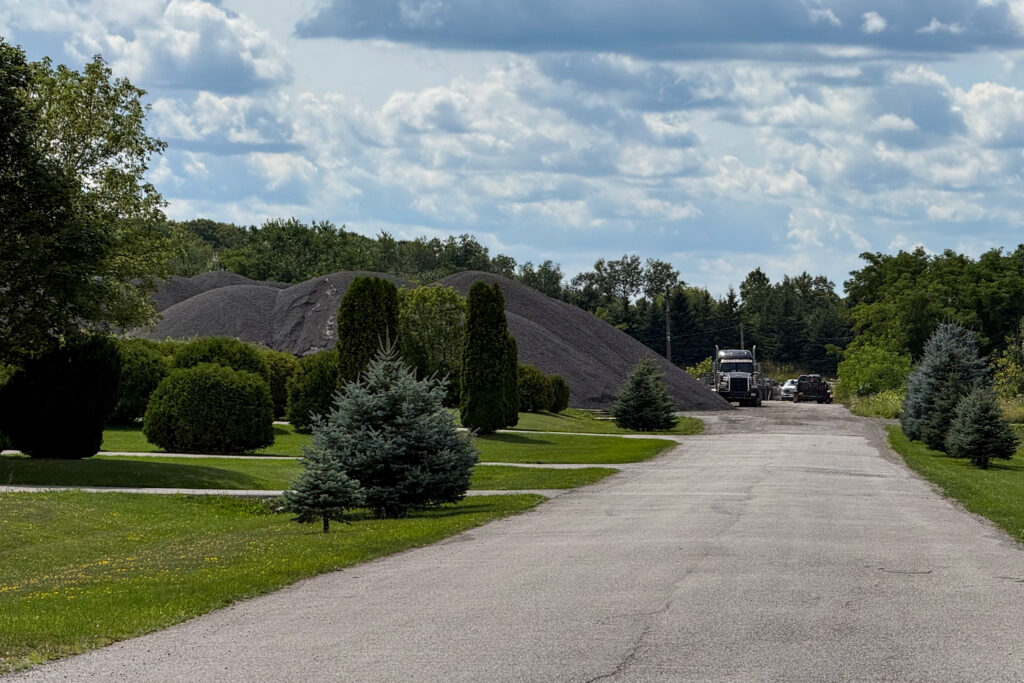
Stockpiles have been present at 14004 Woodbine Ave. over recent years, but rolling hills of material have recently been recently seen from the road. (Aug. 18, 2026 | Bullet Point News)
Freshly paved roads indicate most milling work along Stouffville Road is now complete. Driving the stretch on Aug. 19, coldplaning equipment was seen parked and out of use. At 3009 Stouffville Road, a Forest excavator was loading a truck bed from atop a small pile of grindings.
The site is also within the Oak Ridges Moraine Countryside, and stockpiled material has regularly been observed there. It forms part of a larger staging area being used by the contractor, but it is unclear whether Forest is permitted to use the property for the storage and management of grindings.
According to the Town, by-law enforcement has occurred at the site.
The Contamination Question
Reclaimed asphalt is commonly reused for private driveways and smaller parking areas, particularly in rural settings. It can also be incorporated into new asphalt production in limited amounts.
Asphalt is one of the most reused materials in North America, helping to prevent unsustainable growth of stockpiles. While grindings can be stored at regulated depots for eventual reuse, local by-laws place significant restrictions on the storage of it and other fill materials.
Not generally considered a threat to human health, milled asphalt has been found to contain pollutants, including bitumen. It can also include pollutants associated with decades of road use, such as heavy metals and residues from vehicles, fuels, and oils.
Leaching can occur, so both storage buffer zones and stockyard requirements are in place to prevent it from encroaching on groundwater features, waterbodies, wells, and residences.
Hazardous contamination is another concern. While local by-laws may have provided additional opportunities for testing of dumped grindings, Casey said no asbestos or other contaminants were identified during initial testing of Stouffville Road.
“All Regional road rehabilitation contracts where contaminated materials have been identified include provisions governing the handling, management, and disposal of such material,” he explained. “This road resurfacing project on Stouffville Road did not contain any contaminated material in the asphalt.”
What the By-Laws Require
In Stouffville, limited amounts of imported fill, including milled asphalt, are allowed on a one-time basis without a permit. Beyond minor work such as repaving an existing driveway, most projects involving changes to a property’s grade require a site alteration permit.
The amount of material at the major sites we identified appears to exceed the site alteration by-law’s largest permit-free fill allowance of 450 cubic metres. Although the exact volumes are unknown, larger projects involving 4,000 cubic metres or more of imported fill can be subject to a required public meeting and Council approval.
While exemptions to Stouffville’s Site Alteration By-law exist for work associated with a valid building permit, they would only apply to the portion of the property affected by the proposed building or structure. For 6512 Bethesda, any remaining lot area would likely be subject to the Town’s broader site alteration policies.
If the Town determines that the proposal significantly expands the property’s use, it could constitute “development” under the Planning Act. That would trigger Site Plan Control requirements and a more stringent planning review process.
When required permits or approvals are not obtained, enforcement can range from cease-and-desist orders to mandated site cleanup and remediation. If a property owner fails to comply, the Town can complete the work itself and eventually recover the costs through the property’s tax roll.
Separate, But Connected
Presented with the outcomes of our investigation, and questioned about the project underway at 6512 Bethesda, Sleepy Hollow’s Kurtis Paisley repeatedly emphasized that it is separate from the golf course.
Paisley said he is contracted out by the owner for independent projects. Their plans will support on-site agricultural uses, he told us, and not golf activities or course operations.
“The Bethesda property is planned to have a pole barn put on it for storage of agriculture equipment to maintain the property,” he said. Preliminary work has been done but is not complete, and the berm is intended “solely for aesthetics” to improve the property’s general appearance and minimize impacts on neighbours.
As for the asphalt on the site, Paisley said it will have “minimal depth” when site work is finished.
The gap cut through the northern tree line, however, formed a physical link between the paved Bethesda lands and the golf course. Site conditions observed appear consistent with vehicular movement between the two properties.
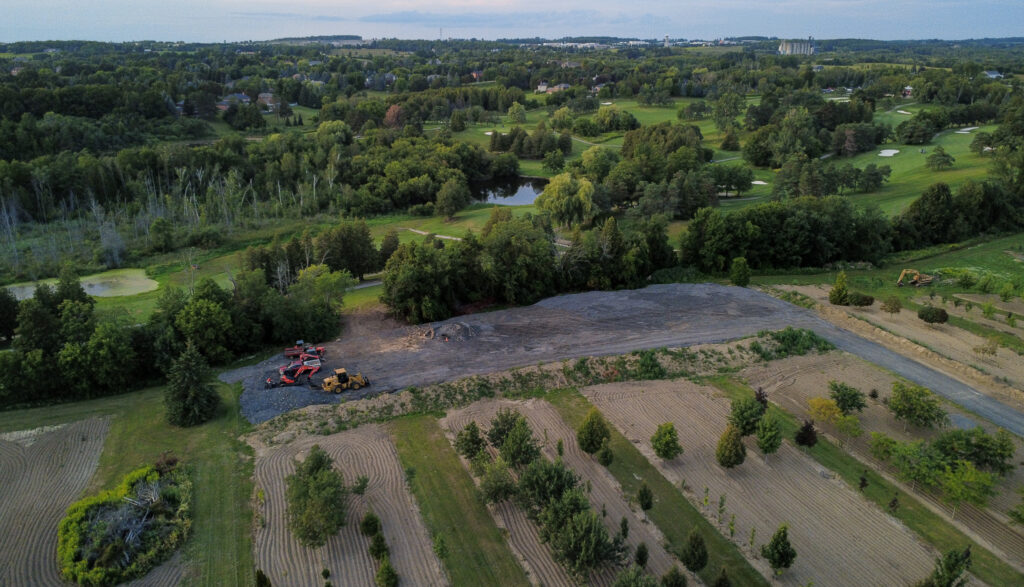
Site alterations at the rear of 6512 Bethesda Side Road have been significant. (Aug. 18, 2026 | Bullet Point News)
According to Paisley, “dead trees posed a threat to members and property and needed to be addressed.” He said the plan is to block the opened gap and treat the two properties separately, adding that the project team will continue work on the area “to ensure safety is met.”
The distinction regarding land use is important: accessory buildings and structures can support agricultural or residential uses within Stouffville’s Oak Ridges Moraine – Countryside (ORM-C) zone, but complex planning applications and review would be needed to allow development, building, or site alterations that expand uses for the golf course.
Amending Stouffville’s Official Plan for that purpose would require supporting studies demonstrating appropriate scale and a clear market need for the expansion. The applicant must also show that there are no consequential impacts to the Moraine’s ecological integrity, and that the change will not adversely impact ongoing agricultural activities in the area.
“Plans and drawings have been submitted to the town, and we are waiting to move forward in the appropriate manner,” Paisley said. The project team is “cooperating fully” and “ensuring every step of the way is complied with.”
The Moraine’s Planning Tests
The Town must now decide whether to require the asphalt’s removal or undertake an after-the-fact planning and permitting process to determine what, if anything, can remain. Additional testing of the material may also need to be conducted.
The paved area will need to satisfy setback requirements, and applicable zoning provisions appear to limit an accessory building to a 200-square-metre footprint. The newly constructed laneway, which stretches along much of the estimated 400-metre property line, exceeds the maximum permitted length of 150 metres. Construction beyond those provisions may require approval from the Town’s Committee of Adjustment.
When reviewing planning and site alteration applications, municipalities play a key role in enforcing the Oak Ridges Moraine Conservation Plan (ORMCP). The Moraine’s Countryside serves as a transition zone, aiming to support rural agricultural and residential uses and protect farmland, aquifers, and natural features.
Regulations dictate that Official Plan policies and development applications for Oak Ridges Moraine lands should not create adverse effects on the surrounding natural environment, current land uses, or neighbouring properties.
Furthermore, mapping shows landform conservation policies within the ORMCP apply to the rear portion of 6512 Bethesda. Development and site alteration proposals that fall within that area are subject to additional review and must demonstrate that the project has been designed to minimize the extent of site alteration required.
Whether those planning considerations ultimately require further changes to the property, or result in approvals, remains to be seen, but what began with illegal dumping has become a broader site alteration, conservation, and by-law enforcement concern.
Beyond the Bethesda site, uncertainty remains over how excess material from a York Region roadworks project was managed, who was responsible for determining the legality of where grindings went, and whether the regulatory and contractual safeguards in place were sufficient enough to prevent what happened.
This article has been corrected: all four sites mentioned are within the Oak Ridges Moraine, not just three.